
Comet's Grand Appearance
The interstellar comet 3I/ATLAS has captured the attention of astronomers and space enthusiasts alike, with recent observations providing unprecedented
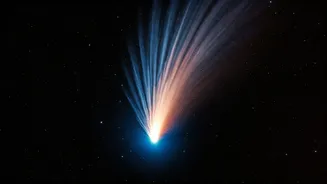
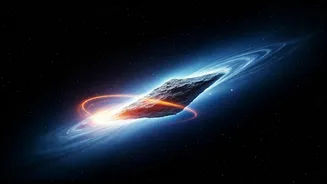
views of this celestial visitor. New images from the Hubble Space Telescope and data from the JUICE Jupiter probe have unveiled intriguing aspects of the comet's structure and behavior. Initial observations show that it does not behave like a typical comet. The way it interacts with sunlight and the resulting formation of its tail are especially noteworthy. Unlike the typical comets, 3I/ATLAS's sun-facing tail exhibits peculiar wobbling jets, indicating a complex interplay of forces. These findings offer a fresh understanding of the dynamics of comets and their journey through the solar system. The discovery is a clear example of the unpredictability and wonder that continues to come from space exploration. Scientists anticipate more discoveries as they analyze the data and look forward to learning more about this comet.
Hubble's Detailed View
The Hubble Space Telescope has played a crucial role in capturing the remarkable details of the interstellar comet 3I/ATLAS. The images from the telescope showcase the comet's structure with exceptional clarity, allowing scientists to analyze its composition and features. These images have been instrumental in confirming the comet's unusual sun-facing tail. Additionally, the images have helped astronomers to observe the comet's interactions with solar radiation, providing a glimpse into the forces driving its movement and shape. Hubble’s observations provide valuable data about the comet, from how it absorbs and reflects light to details of its jets. The resolution and quality of the images allow researchers to study the comet's features. These details, unattainable without advanced technology, contribute to a deeper understanding of cometary activity.
Unusual Tail Wobbles
One of the most surprising findings about the interstellar comet 3I/ATLAS is the peculiar behavior of its tail. Unlike the straightforward, predictable tails of most comets, 3I/ATLAS displays unusual wobbling jets. The sun-facing tail configuration is rarely seen. This erratic movement suggests complex physical processes at play. The wobbling jets indicate that the comet's tail is not simply a stream of gas and dust but is influenced by other forces. The analysis of these jets provides clues about the comet's composition, the dynamics of its interaction with solar winds, and the role of its internal structure. These observations provide a detailed view of the unusual features. Future investigations of 3I/ATLAS will aim to understand the underlying mechanisms that cause these unique characteristics.
Journey Through Space
Interstellar comet 3I/ATLAS, as its name suggests, comes from beyond our solar system, making its journey a voyage across vast cosmic distances. This journey has brought it into our neighborhood, allowing us to study it and understand more about the materials and conditions in other star systems. Studying these comets helps to determine the conditions in the interstellar space. Scientists can measure elements in the comet's nucleus, and measure what the comet is releasing into space. The observations offer a unique opportunity to study the origins of celestial bodies. The study of 3I/ATLAS adds knowledge to our understanding of space.
Impact and Future
The study of interstellar comet 3I/ATLAS has the potential to impact our understanding of comets and space exploration. The unique features of 3I/ATLAS provide insight into the diversity of comets and the forces that shape them. The findings from this investigation could influence future missions aimed at studying interstellar objects. These missions will help to understand the composition, behavior, and evolution of comets. The unexpected behavior of 3I/ATLAS might lead scientists to reconsider previous assumptions about these space objects. As researchers continue to analyze the data from the Hubble Space Telescope and JUICE probe, they anticipate additional discoveries that will reshape our views on space exploration and beyond.