






Cosmic Detritus's Path
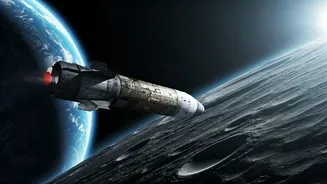
A piece of space hardware, specifically the upper stage of a Falcon 9 rocket from early 2025, is on a predetermined trajectory to collide with the lunar
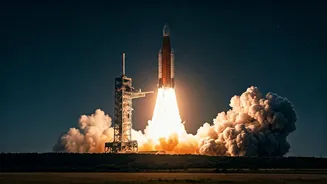
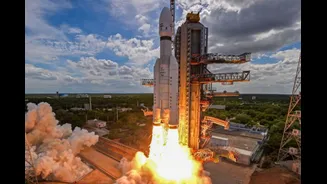
surface. This particular stage was instrumental in launching two commercial lunar landers, though only one successfully touched down. The discarded booster, however, didn't return to Earth but instead entered a lengthy, elliptical orbit that carries it beyond the moon. This prolonged voyage is now nearing its end, with an impending impact scheduled for August 5th. Astronomers have meticulously calculated its path, pinpointing a likely impact zone within or adjacent to the Einstein crater, situated on the western edge of the Moon. The projected time for this event is 2:44 a.m. Eastern Time (0644 UTC) on that date. While these calculations are based on numerous observations, including data from asteroid surveys and telescopes, they will continue to be refined in the months leading up to the predicted collision.
Tracking the Trajectory
The journey of this Falcon 9 upper stage, officially designated 2025-010D, has been closely monitored by astronomers and space agencies. Bill Gray, an independent orbital analyst and developer of specialized tracking software, has been instrumental in these calculations. His work, based on over 1053 observations accumulated as of February 26, 2026, confirms the object's path. These observations were made possible by asteroid surveys that track objects when they are not obscured by the sun or moon. The U.S. Space Force also plays a role in tracking orbital objects, primarily using radar for closer Earth orbits, capable even of identifying small lost items like gloves. For more distant celestial bodies, however, telescopes are the preferred instruments. Visualizations from entities like the Swiss firm s2A Systems have depicted the object's movement across star fields, with intermittent flashes indicating that the stage is not stable but rather tumbling in space. This tumbling motion adds a dynamic element to its final descent.
Impact Details Emerge
The imminent lunar impact involves a substantial piece of machinery: a rocket upper stage weighing approximately 4,000 kilograms and measuring 13.8 meters in length. It's anticipated to strike the Moon's surface at a considerable velocity of 2.43 kilometers per second, equivalent to roughly 8,700 kilometers per hour. Despite the high speed of impact, the event is not expected to pose any danger. Furthermore, it is highly unlikely that the collision will be visible from Earth. This is partly due to the location of the projected impact, which is expected to occur on a portion of the lunar surface that is illuminated by the sun. While Bill Gray expresses strong confidence in the predicted timing and location of the impact, he acknowledges that even subtle forces, such as the continuous pressure of sunlight on the object, can gradually alter its orbit over extended periods. Nevertheless, by August, a very precise understanding of the impact point will be available.
A Rare Celestial Event
This impending collision marks a notably rare occurrence of an artificial object making an unintentional impact on the Moon. It follows a similar event in 2022, where an upper stage from a Chinese Long March 3B rocket, originally launched in 2014 as part of the Chang’e-5T1 mission, crashed into the far side of the Moon. That impact famously created a double crater on the lunar surface. Interestingly, Bill Gray was also the one to first suggest the possibility of that earlier impact, though he initially misidentified the specific rocket stage. In contrast to that instance, the current Falcon 9 upper stage has been continuously tracked since its launch, providing a more reliable and well-understood orbital history leading up to its final destination.