



Mapping Cosmic Architecture
Astronomers have leveraged the remarkable capabilities of the James Webb Space Telescope (JWST) to construct the most detailed map of the universe's largest
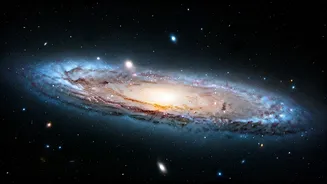
known structure, a vast cosmic scaffolding referred to as the cosmic web. This ambitious undertaking, known as COSMOS-Web, represents the most extensive survey JWST has conducted to date. Its primary objective is to meticulously trace the distribution and evolution of galaxies from the universe's nascent stages, specifically when it was just about 1 billion years old, all the way to the present day. The cosmic web itself is conceptualized by scientists as a colossal, skeleton-like network composed of dark matter and gas filaments, interspersed with expansive, nearly empty regions called voids. Galaxies and clusters of galaxies are not randomly scattered but tend to congregate along these filaments and sheets, akin to how flies might become ensnared in a spider's intricate web. This fundamental structure dictates the large-scale organization of the cosmos, acting as the underlying architecture that guides galactic assembly and development over billions of years.
JWST's Transformative Vision
The findings from the COSMOS-Web project underscore the revolutionary impact the $10 billion James Webb Space Telescope has had on our understanding of the universe since it commenced transmitting data in the summer of 2022. Hossein Hatamnia, the lead researcher from the University of California, Riverside, emphasized that JWST has fundamentally reshaped our cosmic perspective, with the COSMOS-Web survey specifically designed to provide the broad and deep observational scope necessary to effectively study this grand cosmic structure. For the first time, scientists can now meticulously examine how galaxies have evolved within both dense clusters and elongated filamentary arrangements across vast stretches of cosmic history, from the universe's infancy around 1 billion years ago to our relatively close cosmic neighborhood. This 'nearby universe' extends to a distance of roughly 1 billion light-years, a scale that dwarfs our solar system's 2 light-year width and highlights the immense scope of the COSMOS-Web's reach, extending some 13 billion light-years further.
Unprecedented Depth and Resolution
The expansive view provided by COSMOS-Web offers an unprecedented wealth of information, surpassing that of earlier observations of the same celestial region conducted by the Hubble Space Telescope. Bahram Mobasher, a team member and scientist at UCR, highlighted a significant difference when comparing Hubble and JWST data: many previously observed cosmic structures appeared 'smoothed over' in Hubble's images but are now revealed with remarkable clarity by JWST. This dramatic leap in observational depth and resolution is critical, as it now allows astronomers to study the cosmic web at epochs when the universe was merely a few hundred million years old, an era that was largely inaccessible to previous instruments. Structures that previously appeared as single, indistinct entities are now resolving into multiple distinct components, with details that were once blurred now clearly discernible. This enhanced ability to discern fine structures is crucial for understanding the early stages of cosmic evolution.
Synergy of JWST Capabilities
The remarkable increase in detail provided by JWST through the COSMOS-Web survey is a direct result of the synergistic combination of two of the telescope's most powerful attributes. Hatamnia explained that JWST's advanced instrumentation enables it to detect a substantially greater number of faint galaxies within any given field of view. Furthermore, the telescope's precision in measuring the distances to these galaxies is significantly improved. This enhanced accuracy in distance determination allows each galaxy to be precisely positioned within its correct temporal slice of cosmic history. Consequently, the resulting map achieves a far sharper resolution, providing a more accurate and detailed representation of the cosmic web and the distribution of galaxies throughout the universe's lifespan.