



The Resilient Camel
Camels are legendary for their ability to endure weeks without a drink. Their secret lies in storing fat in their humps, which their bodies efficiently
convert into both energy and vital moisture. Furthermore, these desert dwellers significantly minimize water loss through highly concentrated urine and an extraordinary tolerance for dehydration, far exceeding that of most mammals. This allows them to thrive in some of the planet's harshest, driest landscapes, making them a true icon of survival in arid conditions.
Kangaroo Rat's Hydration
The kangaroo rat possesses an almost unbelievable survival capability, capable of living its entire life without ever drinking water directly. Its hydration needs are entirely met by the moisture contained within the seeds it consumes. This small desert rodent also exhibits remarkable kidney efficiency, maximizing water retention. To further conserve precious fluids, it is primarily active during the cooler nighttime hours, avoiding the intense daytime heat that would lead to rapid water loss.
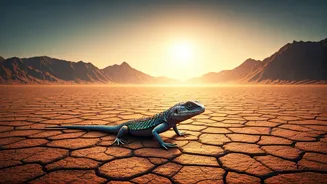
Thorny Devil's Dew Collection
Residing in parched regions, the thorny devil has developed a fascinating method for acquiring water: it absorbs moisture directly through its skin. Microscopic channels etched into its scaly hide expertly collect minuscule dewdrops and any infrequent rainfall, ingeniously directing this collected water towards the corners of its mouth. This remarkable adaptation allows the thorny devil to survive for extended periods, often months, without needing to find open water sources, demonstrating an elegant solution to extreme aridity.
Giraffe's Vegetative Hydration
Despite their imposing stature, giraffes can go for considerable durations without direct access to water. Their primary source of hydration comes from the lush vegetation they consume. The leaves and branches of trees provide them with the essential fluids their bodies require. Moreover, a giraffe's physiology is adept at retaining water efficiently, a crucial trait for an animal that inhabits the arid savannas where waterholes can be few and far between.
Desert Tortoise's Stored Water
The desert tortoise is a master of water conservation, capable of surviving without drinking for many months on end. A key to its survival is its ability to store water within its bladder, drawing upon this reserve when conditions become particularly dry. During periods of drought, this reptile intelligently retreats into its underground burrows, which not only conserves water by reducing evaporation but also shields it from the extreme temperatures prevalent in its desert habitat.
Jerboa's Nocturnal Survival
This diminutive, leaping desert mammal, the jerboa, shares a similar survival strategy with the kangaroo rat. It rarely needs to drink water, obtaining the necessary moisture from the plants and seeds that form its diet. Its nocturnal nature is a significant advantage, as it allows the jerboa to be active during the cooler nights. Coupled with highly efficient kidneys designed for maximum water conservation, the jerboa is perfectly adapted to its arid home.
Sand Gazelle's Arid Resilience
The sand gazelle is another creature that can go for extended periods without drinking water. Its sustenance and hydration are derived from the moisture-rich desert plants it grazes upon. A critical factor in its survival is its remarkable tolerance for extreme body temperatures. This physiological trait allows it to avoid sweating, a primary mechanism of water loss in many animals, thereby conserving precious internal fluids in its harsh environment.