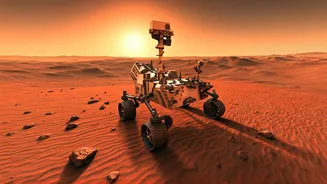








Sojourner's Martian Debut
Sojourner, NASA's pioneering Mars rover, made its debut in 1997, marking a pivotal moment in space exploration. It was the first successful Mars rover deployed
by NASA, initiating a new era of robotic exploration on the Red Planet. This mission offered crucial insights into the Martian environment, paving the path for subsequent rovers. The rover's arrival signaled a technological leap, demonstrating the feasibility of operating robotic vehicles on another planet. Sojourner's mission was pivotal in demonstrating the potential of extraterrestrial surface exploration, opening avenues for future missions and transforming the way scientists examined Mars. The rover's journey also initiated the use of advanced technologies to navigate and analyze the Martian surface, providing essential data for scientists and engineers.
Mission's Duration & Distance
The Sojourner rover's mission was significant, primarily due to its operational success. Although specific figures regarding the exact distance traveled by Sojourner during its mission aren't available, the mission offered critical data. The rover operated in conjunction with the Mars Pathfinder lander, and its prime mission lasted for a specified period. This duration was crucial to gather scientific data and test equipment. Sojourner's mission provided valuable data about Martian rocks, soil composition, and atmospheric conditions, enhancing our understanding of Mars. While the mission was successful, the exact distance the rover traveled is not the main focus, with the mission's achievements being the primary element to highlight. Furthermore, the Sojourner mission's duration and the collected data were crucial in planning and executing subsequent Martian exploration missions.
Design & Mobility System
Sojourner's design incorporated a mobility system to traverse the Martian terrain effectively. Like other rovers such as Spirit, Opportunity, Curiosity, and Perseverance, Sojourner used a specific mobility system to navigate the challenging landscape of Mars. This system facilitated movement across the surface, allowing the rover to conduct its scientific investigations. This design was crucial for accessing various locations and gathering data. This mobility system's success paved the way for subsequent rover designs, improving their abilities to navigate obstacles and cover greater distances. The Sojourner's design demonstrated that rovers could move across the planet, marking a significant advancement in space exploration technology. The mobility system allowed Sojourner to explore the Martian surface, collect data, and send it back to Earth.