





The Melty Blobfish
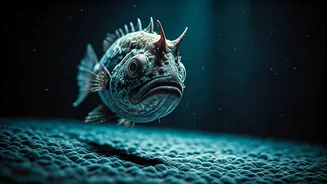
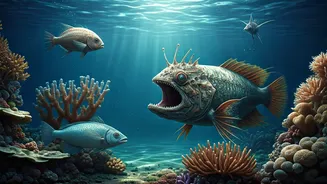
Often misunderstood, the blobfish inhabits extreme depths, nearly 4,000 feet below the surface, where immense pressure shapes its existence. Its survival
hinges on a gelatinous body, lacking significant muscle or a rigid skeleton, which provides natural buoyancy without expending precious energy. The famous 'melted' appearance is a trick of perspective; it only occurs when the fish is brought to the surface. In its natural, high-pressure environment, the blobfish possesses a more conventional fish-like form, illustrating how profoundly an organism's surroundings dictate its physical characteristics. This transformation serves as a stark reminder of the delicate balance between life and its habitat, especially in the ocean's most inhospitable regions.
Beaked Sand-Maker
The striking blue parrotfish is an unmissable inhabitant of coral reefs, renowned not just for its vivid colour but also for its crucial environmental role. Equipped with a beak-like mouth, it diligently scrapes algae off coral structures. During this feeding process, the parrotfish ingests small fragments of the reef's limestone skeleton. Its digestive system then processes this material, ultimately excreting it as fine, white sand. Over its lifespan, a single blue parrotfish can contribute hundreds of kilograms of sand to its surroundings. This fascinating biological function means that many of the world's idyllic sandy beaches owe their existence to the dietary habits of these vibrant fish.
Amazon's Tiny Terror
Among the Amazon River's many inhabitants, the candiru stands out not for its size but for its parasitic lifestyle. This nearly transparent, diminutive catfish is one of the most notorious parasites in freshwater ecosystems. It primarily targets the gill cavities of larger fish, where it attaches itself and extracts nutrients. Despite popular legends about human encounters, the candiru's true ecological significance lies in its highly specialized scavenging behavior. Its remarkable ability to locate and adhere to a host in the often murky waters of the Amazon highlights the extraordinary adaptations that life develops in such a complex and dynamic environment.
The Ancient Oarfish
For generations, the giant oarfish has been linked to tales of sea serpents, and for good reason. As the longest known bony fish, reaching lengths of up to 30 feet, this ribbon-like creature is rarely observed by humans. It dwells in the ocean's 'twilight zone,' a realm where sunlight is extremely scarce. Instead of swimming horizontally like most fish, the oarfish often adopts a vertical posture, drifting passively with deep-sea currents. Its shimmering, silvery skin and a distinctive, mane-like red dorsal fin are features that likely inspired ancient mariners' encounters with what they perceived as mythical monsters rather than a real biological entity.
Prehistoric Goblin Shark
The goblin shark is a remarkable living relic, offering a glimpse into prehistoric marine life. Its most distinctive features include a unique pinkish hue and an elongated, flattened snout. This specialized snout is equipped with electroreceptors, enabling the shark to detect the faint electrical fields generated by potential prey in its dark habitat. What truly sets the goblin shark apart is its extraordinary jaw mechanism; unlike most predatory fish, its jaws are not rigidly fixed to its skull. Instead, they can be rapidly protruded, extending forward at high speed to capture swift-moving prey such as fish and squid. This unusual yet highly effective hunting strategy allows the goblin shark to thrive in an environment where food can be challenging to find, despite its relatively slow swimming capabilities.