


Sunlight's Colorful Secret
The sun, often appearing as a simple white light, is actually a magnificent blend of several colors. These hidden hues are red, orange, yellow, green,
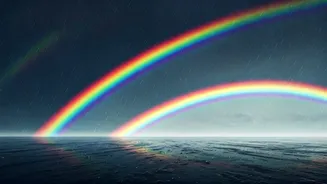
blue, indigo, and violet. When sunlight encounters tiny water droplets suspended in the atmosphere, typically after a rain shower, these individual colors begin to separate. This process, known as the dispersion of light, is the first crucial step in forming a rainbow. It's like the sunlight is unlocking its own secret spectrum, revealing the full palette it contains.
Light's Journey Through Drops
As a ray of sunlight enters a small raindrop, it doesn't just pass straight through. Instead, the light bends, a phenomenon called refraction. Once inside the droplet, the light bounces off the back, a process called reflection. Finally, as the light exits the raindrop, it bends once more. Each of these steps – bending, reflecting, and bending again – works together to further separate the colors of sunlight, making them visible to our eyes as distinct bands.
Rain and Sun Together
To witness the magic of a rainbow, two key elements must be present simultaneously: rain and sunshine. The sun needs to be positioned behind you, while the rain should be in front of you. This alignment is why rainbows are most commonly observed in the early morning or late afternoon, when the sun is lower in the sky and casts its light at an angle conducive to rainbow formation. Without this specific interplay of light and moisture, the conditions for a rainbow simply won't align.
The Curve Explained
The iconic curved shape of a rainbow arises from the way light reflects within millions of spherical raindrops present in the air. Each raindrop acts like a tiny prism, sending light back in a circular pattern. From our perspective on the ground, we can only perceive a portion of this full circle, resulting in the familiar arc. If you were to view a rainbow from a higher vantage point, like an airplane, you might even be able to see the complete circular form.
Rainbows at Home
The wonder of rainbows isn't exclusive to the sky; you can create your own miniature versions at home! A simple yet fascinating experiment involves using a glass of water placed in direct sunlight or a garden hose spraying a fine mist. By directing light through these water droplets, you can observe the principles of dispersion and refraction in action, much like nature does. This hands-on activity is a fun way for children to engage with and understand basic scientific concepts about light and color.