





Why Collision Avoidance?
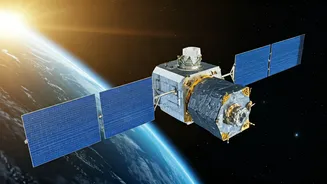
The Earth's orbit, once a relatively empty space, has become significantly crowded with satellites. These satellites provide essential services like communication,
navigation, and Earth observation. The growing number of objects, including active satellites, defunct satellites, and debris from past collisions or explosions, poses a major risk. A collision in space, especially at high speeds, can generate vast amounts of debris, creating a cascading effect known as the Kessler syndrome. This syndrome suggests that the density of objects in low Earth orbit could increase to the point where collisions become self-sustaining, rendering space unusable for future generations. The importance of collision avoidance is thus clear: to protect existing satellites and ensure the future of space exploration and utilization. It safeguards valuable assets and prevents the creation of more space debris.
Detecting Potential Threats
The first step in collision avoidance is precisely tracking all objects in orbit. This is typically done through a combination of ground-based radar systems, optical telescopes, and even onboard sensors on the satellites themselves. These tracking systems monitor the positions, velocities, and trajectories of all cataloged objects. The data collected is continuously analyzed to predict future positions and identify potential close approaches. Organizations like the United States Space Surveillance Network (SSN) and the European Space Agency (ESA) are central to this monitoring process. They gather and process vast amounts of data to provide warnings to satellite operators. Sophisticated algorithms are used to model the motion of objects, taking into account factors like gravitational forces, solar radiation pressure, and atmospheric drag. When a close approach is predicted, a risk assessment is conducted, evaluating the probability of collision and the potential consequences.
Maneuvering to Safety
If a potential collision is identified, the next step involves maneuvering the satellite to avoid it. This requires precise calculations and timely execution. Satellite operators must determine the best course of action, considering factors like the satellite's capabilities, fuel reserves, and the risks associated with various maneuvers. Several avoidance strategies can be employed. The most common is a small orbital adjustment, or 'nudge', to move the satellite away from the predicted collision point. The timing of the maneuver is crucial; it must be executed sufficiently in advance to avoid the risk while conserving fuel. Sometimes, the safest course of action is to do nothing, particularly if the probability of collision is low, and the maneuver could introduce additional risks. The decision-making process is a complex one, involving careful analysis and communication between ground controllers and the satellite operators.
Technological Advances Ahead
The field of satellite collision avoidance is continuously evolving, driven by the increasing number of objects in space and the potential for severe consequences. Several technological advancements are expected to further improve safety. One important area is the development of more accurate tracking systems, able to monitor smaller objects and provide more precise predictions. Another is the use of artificial intelligence and machine learning to automate the risk assessment and maneuver planning processes. AI can analyze vast amounts of data and identify patterns that might be missed by human operators, leading to faster and more effective decision-making. Furthermore, there is growing interest in developing active debris removal technologies. These could remove existing debris and reduce the risks of future collisions. Improved cooperation and data sharing among spacefaring nations will also be critical in promoting safe and sustainable space operations.
Future of Space Safety
The future of space safety depends on continuous innovation and international cooperation. As space becomes more crowded, effective collision avoidance is no longer just a technical challenge but a necessity for the sustainable use of space. New technologies, more sophisticated tracking capabilities, and intelligent automation will play a vital role. Furthermore, international collaborations and agreed-upon best practices are essential. These practices will facilitate data sharing, enhance communication, and promote the responsible operation of spacecraft. By focusing on these priorities, the international space community can ensure that space remains a viable environment for exploration and the delivery of critical services for future generations. The safety of the space environment is paramount for all, and the continued development of collision avoidance techniques will be essential for success.