






AI Computing's Trillion-Dollar Horizon
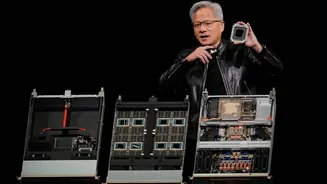
At its flagship annual event, Nvidia's Chief Executive Officer, Jensen Huang, projected an astounding $1 trillion in sales revenue through 2027, directly
attributed to the immense demand for its advanced AI processors. This significant forecast underscores Nvidia's pivotal role in powering the artificial intelligence revolution. The company's ongoing strategy involves not only meeting the escalating global need for computational power but also fostering sustained customer loyalty to its technological ecosystem. Huang highlighted the dramatic surge in computing requirements over the past two years, noting a million-fold increase, a sentiment echoed across the burgeoning startup landscape. This projection, bolstered by anticipated orders for its Blackwell and Rubin chips, aims to reassure investors about the enduring strength of Nvidia's market position and its capacity for continued growth, even as the company expands its product portfolio.
Expanding the Tech Frontier
Nvidia is aggressively diversifying its product offerings beyond its core accelerators, venturing into the territory traditionally dominated by central processing units (CPUs). During a comprehensive keynote, Huang announced initiatives to develop chips incorporating technology acquired from the startup Groq, specifically designed to enhance AI responsiveness. Furthermore, the company revealed plans for specialized semiconductors tailored for data centers situated in extraterrestrial environments, showcasing an ambitious scope. This expansion into CPUs, which are fundamental for managing complex workloads in AI data centers, represents a strategic move to offer more integrated computing solutions. The company is not just selling hardware; it's also providing AI models and software on an open-source basis, encouraging innovation and customization among its diverse clientele across various industries.
Next-Gen Processors Unveiled
The GTC event served as a platform for revealing Nvidia's next generation of flagship AI processors. Following the current Blackwell generation, the company announced the upcoming 'Vera Rubin' chip, slated for release in the latter half of 2026, named after the pioneering astronomer. This will be succeeded by a processor named after physicist Richard Feynman. These new designs are part of Nvidia's accelerated development cycle, aiming to refresh its entire product lineup annually. The Rubin chip will feature customized high-bandwidth memory, hinting at enhanced performance for sophisticated AI tasks. The company's continuous innovation in processor technology is crucial for maintaining its competitive edge in the rapidly evolving AI hardware market.
Innovations in AI Acceleration
A key announcement at GTC was the integration of the Groq 3 Language Processing Unit (LPU) into Nvidia's product catalog. LPUs are specialized semiconductors engineered to excel at accelerating the inference process for large language models, which involves generating responses to AI prompts. These chips are equipped with high-speed onboard memory, enabling near-instantaneous text generation. Nvidia intends to offer the LPU as a complementary component alongside its accelerators, which are better suited for handling more complex, multi-stage computational tasks. This strategic inclusion of Groq's technology, following a licensing agreement and the integration of Groq's engineering team, accelerates the availability of this advanced AI processing capability. Samsung will manufacture the Groq-based processors using its 4-nanometer technique.
CPU Integration and Market Strategy
Nvidia is embarking on a new strategic path by planning to offer complete computer systems built entirely from CPUs. This represents a significant shift for the company, which has historically focused on GPUs and accelerators. The new 'Vera' CPU line is designed to be more versatile, combining features beneficial for data centers, gaming PCs, and laptops, while also being more power-efficient. These new CPU-centric machines can operate independently or in conjunction with existing Nvidia-based systems. This move poses a potential challenge to established CPU manufacturers like Intel and AMD, while also intensifying competition with in-house chip development efforts by major cloud providers. By offering a broader range of processors, Nvidia aims to capture a larger share of the computing market.