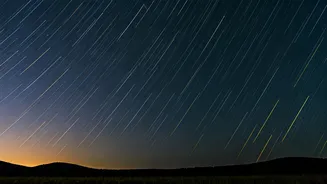







Peak Viewing Insights
The Eta Aquarid meteor shower graces our skies annually, typically gracing us with its presence between April 19 and May 28. For 2026, the peak viewing
window is expected to be overnight May 5-6. To catch the most impressive display, aim for the pre-dawn hours of May 6th, as this is when the shower's radiant point, the area from which the meteors appear to originate, reaches its highest position in the sky. However, a significant factor to consider for this particular year is the presence of a bright waning gibbous moon during the peak. This bright moonlight can unfortunately wash out many of the fainter meteors, reducing the number visible to the naked eye. While the Southern Hemisphere and equatorial regions offer the most prolific views, observers in some northern latitudes can still catch a glimpse of this celestial show.
Cosmic Debris Explained
The breathtaking phenomenon of the Eta Aquarid meteor shower is intrinsically linked to a legendary visitor of our solar system: Halley's Comet. As Earth traverses the orbital path of this famous comet, it encounters a trail of icy and dusty debris left behind. These tiny particles, often referred to as 'comet crumbs,' enter our planet's atmosphere at astonishing speeds. The intense friction generated by this atmospheric entry causes them to heat up and incinerate, creating the brilliant streaks of light we perceive as shooting stars. Halley's Comet, known for its roughly 76-year orbit around the sun, last graced the inner solar system in 1986 and is not expected to return until 2061. Its namesake, English astronomer Edmond Halley, meticulously studied historical comet sightings and astutely deduced that multiple historical accounts referred to the same recurring celestial body, leading to its eventual naming.
Where to Look Skyward
Meteor showers derive their names from the constellation that appears to be their origin point from our vantage point on Earth. For the Eta Aquarids, this apparent source is the constellation Aquarius. From our perspective, these meteors seem to emanate from the region of the sky defined by Aquarius's coordinates: right ascension of 23 hours and declination of -15 degrees, making them visible to observers between latitudes of 65 and -90 degrees. While the shower's radiant is in Aquarius, it's crucial to understand that this constellation is not the actual source of the meteoroids. Looking directly at Aquarius may cause you to miss many of the meteors, as they can be seen streaking across the entire expanse of the night sky. To maximize your chances, widen your gaze to include neighboring constellations. Meteors appearing closer to the radiant tend to have shorter, less prominent trails, making them harder to spot, so a broader view is essential for appreciating the full spectacle of the Eta Aquarids.
Maximizing Your Viewing
To truly immerse yourself in the Eta Aquarid meteor shower, the key is finding the darkest possible location away from city lights. Once you've settled in, recline comfortably, perhaps with a blanket or chair, and allow at least 30 minutes for your eyes to fully adapt to the darkness. This period is crucial for maximizing your sensitivity to the fainter meteors. It's strongly advised to avoid using any bright light sources, including your smartphone screen, as these will instantly ruin your night vision. If you must use a flashlight, ensure it has a red-light setting, which is less disruptive to your eyes' adaptation. The ideal viewing time, according to experts like Bill Cooke from NASA's Marshall Space Flight Center, is around 2:00 a.m. local time. From this point onward, the rate of visible meteors is expected to increase steadily until the break of dawn. It's important to remember that the radiant point of the Eta Aquarids is not visible shortly after sunset, so patience and waiting until the early morning hours are essential for the best experience.