






Eclipse Timings & Indian Viewing
On March 3, 2026, the sky will offer a breathtaking display with the year's inaugural total lunar eclipse, also known as Chandra Grahan. This celestial
event requires no special equipment, only a clear evening and a moment to look up. For viewers across India, the experience will be unique, as the Moon will already be partially obscured as it rises. This means only the latter stages of the eclipse will be visible, offering a window of approximately 20 minutes to observe the Moon's journey out of Earth's shadow, primarily around sunset. The key timings in Indian Standard Time (IST) are: the penumbral phase begins at 4:58 PM, totality commences at 4:58 PM, the total phase concludes at 5:32 PM, and the penumbral phase ends at 7:53 PM. Consequently, skygazers in India should focus their attention on the dusk sky to catch the most dramatic moments of this lunar phenomenon.
Visibility Across India
The visibility of the total lunar eclipse on March 3, 2026, varies across India, with the Northeast regions offering the most complete viewing experience. Cities in Assam, such as Dibrugarh, Dispur, and Guwahati, along with Itanagar in Arunachal Pradesh and Shillong in Meghalaya, are predicted to witness 100 percent obscuration during the total phase of the eclipse. While the eclipse begins at 14:14 IST across these locations, the maximum obscuration phase is expected to occur around 17:11 to 17:25 IST, depending on the specific city. The total duration of totality for these northeastern cities is approximately 3 hours, 27 minutes, and 8 seconds, with the penumbral phase concluding at 19:53 IST. For the rest of India, the Moon will be rising already within the Earth's shadow, offering a partial view of the eclipse's latter stages, making the northeastern states prime locations for observing the full spectacle.
Understanding Lunar Eclipses
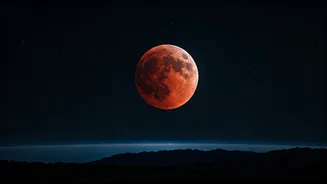
A lunar eclipse is a mesmerizing astronomical event that occurs when the Sun, Earth, and Moon align in a specific order, with the Earth positioned directly between the Sun and the Moon. During this alignment, the Earth casts its shadow upon the lunar surface. This shadow causes the Moon to dim and can also impart a distinct reddish hue, often referred to as a 'Blood Moon,' due to sunlight scattering through Earth's atmosphere. Lunar eclipses happen periodically, but their visibility is geographically limited. The March 3, 2026, event is particularly noteworthy for its visibility in India, offering a chance for many to witness this captivating natural phenomenon firsthand.
Viewing the Eclipse Safely
Watching a total lunar eclipse is remarkably straightforward and entirely safe, requiring no specialized protective eyewear unlike solar eclipses. As long as the skies are clear, anyone can observe the eclipse by simply stepping outside and looking up at the Moon. While binoculars can enhance the view, offering a more magnified perspective of the Moon's surface and its changing appearance, they are by no means essential. The subtle yet significant transformation of the Moon as it passes through Earth's shadow is clearly discernible to the naked eye. Therefore, as March 3, 2026, approaches, remember to check the weather forecast and prepare to enjoy this accessible and unforgettable celestial show.