








Veteran Engineer's Claims
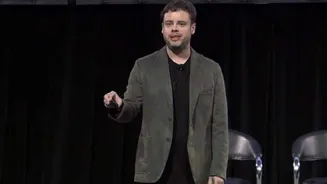
A significant kerfuffle has erupted following statements made by Steve Yegge, a seasoned software engineer formerly employed by Google. Yegge shared a purported
conversation with a long-standing tech director at Google, suggesting that the company's internal embrace of AI technology is surprisingly sluggish. He characterized this adoption rate as mirroring that of agricultural machinery manufacturer John Deere. Yegge further elaborated on X, a social media platform, that typical internal AI adoption patterns involve a small group of enthusiastic users (20%), a similar number of outright objectors (20%), and a majority (60%) who fall somewhere in between, often using tools like Cursor or comparable chat interfaces. He asserted that Google's internal scenario reflects this common industry distribution. While Business Insider has not independently verified these assertions, which were presented as hearsay, Google did not offer a comment when approached for their perspective.
Public Backlash Ensues
Yegge's widely publicized comments triggered a strong reaction from within Google, with employees across various levels voicing their dissent. The most prominent response came from Demis Hassabis, the CEO of Google DeepMind. Hassabis directly addressed Yegge on X, expressing considerable disagreement. He advised Yegge to encourage his contact to 'do some actual work' and cease spreading what Hassabis described as 'absolute nonsense' and 'pure clickbait,' deeming the original post entirely inaccurate. This public exchange escalated when Yegge responded to Hassabis, stating he would issue an apology only if Google could substantiate that a substantial portion of their engineers are actively utilizing AI tools, specifically mentioning a usage of '4M tokens a day' as a potential benchmark for convincing him.
Yegge Doubles Down
A week after his initial controversial post, Yegge intensified his critique, asserting that he had received communications from numerous Google employees across different departments. These individuals, he claimed, revealed a 'two-tier system' within the company's AI usage. According to Yegge, engineers within Hassabis's DeepMind team extensively use Anthropic's Claude as their primary daily tool. In contrast, the broader Google workforce, he alleged, does not have the same access or encouragement to use it, instead being directed towards internal versions of Gemini. Yegge concluded that this situation does not paint a picture of a healthy or advanced engineering organization. He also highlighted that Anthropic's Claude is widely regarded as an industry leader for AI coding assistants, with Google and OpenAI striving to compete after initially falling behind in the development of large language models, a field where Google's foundational research played a key role.
Conflicting Statistics Emerge
Addy Osmani, a director at Google Cloud, publicly challenged Yegge's assertions, stating that the claims did not accurately reflect the current state of 'agentic coding' within the company. Osmani provided a statistic indicating that over 40,000 Google software engineers utilize agentic coding on a weekly basis, positioning Google favorably against other leading technology firms. However, Yegge contested Osmani's figure, arguing that simply using a tool weekly does not equate to genuine adoption or meaningful integration. He characterized such usage as merely 'checking boxes,' suggesting that a low usage threshold like 'weekly' could include individuals who experimented with the tools once and then reverted to traditional coding methods. Yegge framed the company's collective response as an attempt at damage control, urging people to trust the accounts of those working within Google rather than official statements.