






Mont Saint-Michel's Majesty
In Normandy, France, stands the iconic Mont Saint-Michel, an island commune crowned by a magnificent abbey. Legend has it that Bishop Aubert built a chapel
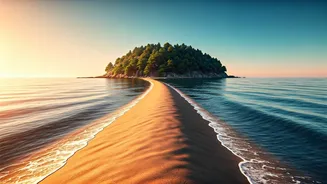
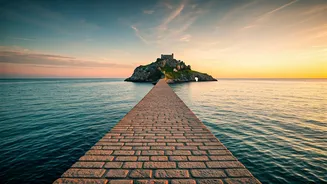
here in 708 after a divine vision. The island's focal point is its abbey, a UNESCO World Heritage site, whose gilded spire, topped with a figure of Archangel Michael vanquishing a dragon, dominates the skyline. Visitors ascend the Grande Rue, navigating past shops and eateries, to reach the abbey, much of which can be explored independently. Guided tours, usually commencing around 11 am and 3 pm between October and March, with more frequent offerings in spring and summer, provide deeper insights into its rich history and architecture. This island truly embodies a fairy-tale landscape, accessible by a causeway that appears as the tide retreats.
Brough of Birsay's Past
Off the coast of Orkney, Scotland, the Brough of Birsay is an outcrop steeped in history. Ancient Pictish settlements from the 7th and 8th centuries have left their mark, followed by Norse settlers who established impressive Viking longhouses around the 10th century. By the 12th century, the Brough served as the administrative center for Orkney's rulers, with the ruins of St. Peter's Church bearing testament to this era. The island's desolate beauty is amplified by puffin colonies and dramatic cliffs dotted with lighthouses. A concrete path, submerged at high tide, miraculously emerges to guide visitors across, offering an otherworldly experience that connects you to the island's rich past.
Noirmoutier's Seaside Charm
Brittany, France, boasts the enchanting island of Noirmoutier, linked to the mainland near Beauvoir-sur-Mer by the Passage du Gois, a 4.5km stretch of road that surfaces only during low tide. This picturesque island is characterized by its charming whitewashed houses with blue shutters, vibrant hollyhocks, and shimmering salt pans. A medieval castle adds to its storybook appeal. While the passage can be traversed by vehicle, walking is a more rewarding experience, allowing you to join locals in searching for cockles and clams in the exposed sand. Vigilance regarding tide times is crucial, or one may need to seek refuge on safety poles until the waters recede.
Jindo's Miraculous Road
In South Korea's southwestern region, the islands of Jindo and Modo are linked for a few days each year by the Ganjuyuk Gyedo, a remarkable 2.8km-long, 40m-wide causeway revealed by an exceptionally low tide. This natural phenomenon, celebrated in Korean legend, draws approximately 300,000 visitors to the Jindo Miracle Sea Road Festival. Attendees, often clad in knee-high rubber boots, eagerly make the crossing, experiencing the magic of the sea parting to create a temporary land bridge. This event highlights a unique intersection of natural wonder and cultural tradition, drawing crowds to witness this extraordinary occurrence.
Minister's Island Grandeur
New Brunswick, Canada, features Minister's Island, an isle reachable at low tide via a 1km walk across the ocean floor, only to be submerged again at high tide. Originally purchased by Reverend Samuel Andrews in 1790 to minister to his parishioners, the island's modest stone cottage remains. Later, in 1890, railway magnate William Cornelius Van Horne transformed it, constructing an extravagant 50-room "cottage" complete with 17 bedrooms, 11 fireplaces, and a windmill to supply running water. A visit here offers a captivating journey back in time, immersing one in the faded opulence of the Edwardian era, a stark contrast to the natural ebb and flow of the tide.
Haji Ali Dargah's Serenity
Mumbai, India, is home to the Haji Ali Dargah, a serene Sufi shrine perched on an islet. According to legend, the 15th-century Muslim saint Pir Haji Ali Shah Bukhari's shroud miraculously returned to this rocky outcrop after his death during a pilgrimage to Mecca, leading his followers to construct a white marble mosque to house his tomb. Often appearing like a mirage shimmering over the sea, the Dargah becomes accessible via a rising causeway at low tide. Devotees flock to this sacred site, especially on Fridays, when Sufi devotional singers fill the air with spiritual melodies, creating a profound sense of peace and connection.
Bar Island's Natural Bridge
Off the coast of Bar Harbor, Maine, USA, lies Bar Island, a landmass that is only partially surrounded by water. As the tide recedes, a natural gravel land bridge emerges from the sea, creating a 1.5km pathway from the mainland's Bridge Street. Visitors can explore the island's diverse landscape, which includes forests, meadows, and a rocky shoreline. A trail ascends to a small peak, offering picturesque vistas of the surrounding ocean and mountains. As part of Acadia National Park, renowned for its rugged coastal scenery, Bar Island provides a beautiful natural escape accessible by this temporary land connection.
Lindisfarne's Pilgrim's Way
Near the Scottish border lies Lindisfarne, or Holy Island, in Northumberland, England. This windswept isle retains its remote character, much as it did when St. Aidan established his monastery here in 635. Twice daily, the tides recede, revealing the Pilgrim's Way, a path through sand and mudflats that has served travelers for centuries. Marked by a line of vertical poles along its 5km route, the journey leads to ancient abbey ruins, a dramatic hilltop castle, and a bird reserve that hosts species like merlins and bar-tailed godwits. Lindisfarne offers a deeply historical and naturally captivating experience, accessible only when the sea allows.
Mandø's Tractor Adventure
In Denmark's Wadden Sea, near Ribe, lies the tranquil island of Mandø. This secluded spot offers a serene experience with vast expanses of grass, grazing sheep, and a small community of about 60 inhabitants under an expansive sky. While a causeway does surface at low tide, its muddy terrain makes walking impractical for most. Instead, visitors typically opt for the unique experience of riding a tractor-pulled bus, its robust tires navigating the challenging muck. This unconventional transport continues until the tide returns, once again transforming Mandø into an island adrift in the sea.