




Orbital End Approaches
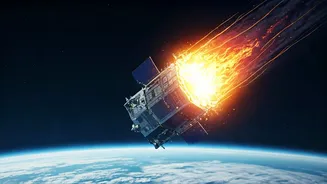
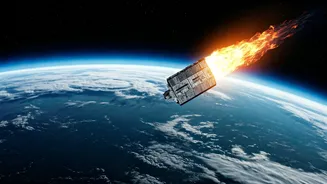
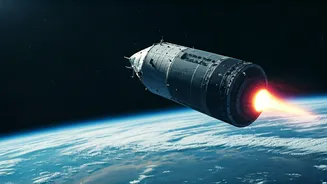
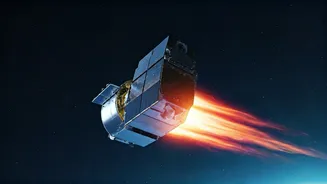
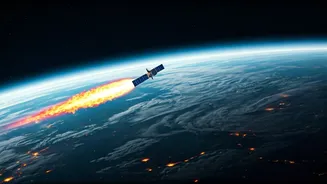
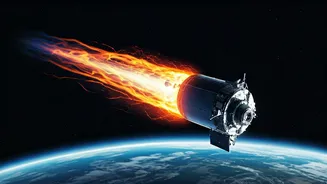
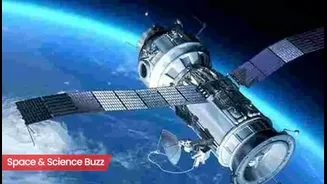
After an impressive nearly 14-year tenure in orbit, NASA's Van Allen Probe A, weighing approximately 1,323 pounds (600 kilograms), has begun its journey
back towards Earth. This spacecraft, launched in August 2012 alongside its twin, Van Allen Probe B, was designed to investigate the dynamic radiation belts encircling our planet. The mission's operational phase concluded in 2019 for both probes, but Probe A's orbital lifespan has now reached its inevitable conclusion. The scientific community anticipates that the vast majority of the satellite will disintegrate and vaporize as it encounters the denser layers of Earth's atmosphere. However, there's a possibility that some robust components might survive this fiery passage. These surviving fragments are expected to land in oceanic regions, significantly diminishing any potential threat to human populations. The probability of injury from falling debris is estimated to be exceedingly low, around a mere 0.02 percent, or about 1 in 4,200 chances.
Mission's Extended Life
Initially conceived with a two-year operational lifespan, the Van Allen Probes, originally named the Radiation Belt Storm Probes, far surpassed initial expectations. These probes followed a highly elliptical orbit around Earth, venturing as far as 18,900 miles (30,415 km) from the planet and dipping as low as 384 miles (618 km). Van Allen Probe A continued its vital data collection until October 2019, while Probe B remained active until July 2019. Recent years have seen increased solar activity, which has led to the expansion of Earth's atmosphere. This atmospheric inflation has, in turn, increased the frictional drag experienced by satellites in lower orbits. It is believed that this heightened drag is the primary reason for Van Allen Probe A's earlier-than-anticipated descent back to Earth.
Scientific Contributions Unveiled
Throughout their extended service, the Van Allen Probes meticulously gathered crucial data on the complex radiation environments surrounding Earth. This information has been instrumental for scientists aiming to understand the profound impact of solar activity on various systems. The insights gained have helped improve our ability to forecast space weather events, which can disrupt satellite operations, endanger astronauts, and even affect critical terrestrial infrastructure such as GPS, communication networks, and power grids. By studying the behavior of charged particles within these belts, researchers have developed more accurate predictions for hazardous space weather phenomena and enhanced the planning for future space missions, better anticipating potential risks from solar storms.
Future Descent of Probe B
In contrast to Probe A's impending return, its twin, Van Allen Probe B, is not projected to re-enter Earth's atmosphere until approximately 2030. Probe B's orbital decay appears to be less influenced by the recent increases in solar activity compared to its counterpart. Both probes, though deactivated, continue to serve a purpose in orbit until their eventual re-entries. They remain valuable reference points for scientists monitoring space weather and its cascading effects. Furthermore, the observation and analysis of their descent trajectories provide vital data for understanding orbital mechanics and atmospheric drag, knowledge that is directly applicable to the longevity and operational planning of other satellites currently in active service.