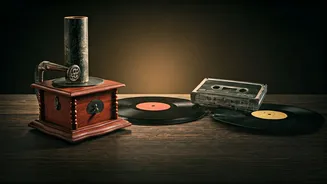

Early Sound Beginnings
The phonograph, a revolutionary device conceived by Thomas Edison in 1878, ushered in the age of recorded music. This ingenious invention utilized wax
cylinders to capture and reproduce sounds. Before this breakthrough, listening to music was limited to live performances. The phonograph changed this limitation, laying the foundation for a shift from live musical experiences to repeatable audio entertainment. This technological leap forward sparked a new era for music lovers everywhere, offering the ability to revisit and share musical moments in a way never before possible. It was the first step in a long journey of innovation that would redefine how people interacted with and appreciated music.
Gramophone's Flat Discs
Emile Berliner's gramophone marked a pivotal shift in the 1900s, introducing flat disc records to the world. These discs quickly superseded the cylinder format in popularity. The advantage of these discs was clear: they facilitated the growth of personal music collections. As playback machines became stylish household items, music started to enter more homes, becoming an important cultural element. This transition emphasized the growing demand for recorded music and the shift towards owning and experiencing music within the privacy and comfort of one's own home, making music more accessible to the masses.
Vinyl's Dominant Era
From the 1940s to the 1960s, vinyl records took center stage as the preferred music format. They were lighter and less expensive than the earlier shellac discs, making them more attractive. This era also witnessed the rise of 7-inch singles and 12-inch albums, further enhancing music's accessibility, particularly for youth culture and emerging musical trends. Vinyl became an important feature of cultural movements, reflecting the times and enabling music lovers to easily embrace and explore the evolving sounds of the era. The format's affordability and availability accelerated the spread of diverse musical styles and the popularity of musical artists.
The Rise of 8-Tracks
The 1970s brought the 8-track cartridge to the forefront. This format offered a convenient way to enjoy music, especially while on the move, primarily in cars. Although 8-tracks weren't without their drawbacks, their impact showed a shift toward making music listening more portable. This format paved the way for more advancements in music technology, reflecting the increasing demand for on-the-go music access, setting the stage for even more revolutionary formats to come that would further enhance portability and user experience. 8-tracks, in their way, played a role in shaping how people would eventually enjoy music.
Cassettes and Portability
The 1980s heralded a new era of portability with the arrival of audio cassettes. This format made music even more accessible, enabling fans to curate their own mixtapes and share their favorite songs. Sony's Walkman took things further, transforming personal listening by popularizing headphones and portable music players. This innovation reshaped listening habits by introducing individual music experiences, changing music culture. The blend of cassettes with the Walkman enhanced individual choices and changed the way music became an integral element of daily lives, letting people enjoy their favorite tunes anytime, anywhere, and in a way that was uniquely their own.
CDs and Digital Sound
From the 1980s into the 1990s, the compact disc (CD) arrived, bringing digital sound quality that was promoted as 'perfect sound forever.' CDs provided a higher capacity than vinyl or cassettes, which affected how artists arranged their albums and how fans collected music throughout the 1990s. The move to digital marked a big step in audio quality and opened up possibilities in terms of storage, durability, and user experience. The CD's ability to offer a flawless sound experience changed the way people perceived and cherished their music, ushering in a transformative period in music consumption.