





A New Mission Objective
The upcoming 12th test flight of SpaceX's Starship megarocket, scheduled for Tuesday, May 19, is poised to be a landmark event, marking the initial launch
of the advanced V3 vehicle. This iteration of the colossal rocket, the most powerful ever constructed, follows a nearly seven-month hiatus, attributed to significant upgrades. While the flight path remains a familiar suborbital trajectory, the mission introduces a novel in-flight activity: an in-depth self-assessment. The upper stage, designated 'Ship,' will release 22 simulated Starlink broadband satellites. These mock satellites, designed to mirror the dimensions of next-generation Starlink constellations, are a critical component of this flight's experimental agenda. Their deployment is not just for practice; it's a strategic move to gather essential data, particularly concerning the integrity and performance of Starship's protective thermal shielding during atmospheric reentry.
Inspecting the Heat Shield
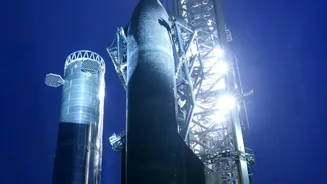
A pivotal aspect of Flight 12 involves the deployment of two specialized inspector spacecraft from the batch of 22 simulated Starlink satellites. These unique craft are engineered to meticulously scan Starship's heat shield, transmitting detailed imagery back to ground operators. The primary goal is to evaluate and refine methods for assessing the heat shield's condition, ensuring its readiness for subsequent launches following re-entry. To aid this examination, several tiles on Starship's hull have been painted white, simulating the appearance of missing tiles and serving as explicit targets for the imaging equipment. This focused inspection underscores the critical importance of the heat shield, especially given Starship's ambitious design for complete and rapid reusability, a challenge far exceeding that faced by single-use heat shields like those on NASA's Orion capsule.
The Reusability Challenge
The reusability of Starship's heat shield, comprising approximately 40,000 hexagonal tiles, has been identified by SpaceX founder Elon Musk as the most significant obstacle to the vehicle's operational success. Unlike the heat shields on single-use spacecraft, Starship's shield must withstand the intense conditions of atmospheric reentry not just once, but potentially multiple times a day. While previous test flights have demonstrated Starship's ability to survive re-entry and splash down, the loss of numerous tiles during these events necessitates substantial improvements for true reusability. The current laborious process of inspecting thousands of tiles post-flight is incompatible with SpaceX's vision of rapid turnaround, requiring a landing, refuelling, and immediate relaunch. Flight 12's in-orbit inspection aims to gather data that will accelerate the development of a robust and reusable heat shield system.
Flight Plan Details
The operational plan for Flight 12 outlines distinct splashdown procedures for both stages of the Starship rocket. Approximately seven minutes after liftoff, the first stage, known as Super Heavy, will execute a controlled descent and splashdown in the Gulf of Mexico. Notably, this flight will not feature the 'chopstick' arms of the launch tower attempting to catch the booster, a manoeuvre observed in prior test flights. Meanwhile, the Starship upper stage, Ship, is scheduled for a splashdown in the Indian Ocean roughly 65 minutes post-launch, a landing profile previously achieved on earlier missions. However, the crucial difference this time will be the unprecedented in-space visual data of the heat shield's performance during the fiery descent, offering vital insights into the effectiveness of the reentry process and the path toward full reusability.