




A Comet's Perilous Path
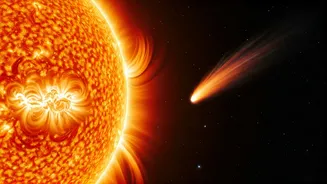
Prepare to witness a truly dramatic cosmic event as comet C/2026 A1 (MAPS) embarks on its final, high-stakes journey towards the sun. This celestial wanderer,
believed to be part of the enigmatic Kreutz family of comets, is hurtling towards a critical moment known as perihelion on April 4. These comets share a common origin and are known for their daring orbits that bring them incredibly close to our star. At its closest point, C/2026 A1 (MAPS) is predicted to skim just 101,100 miles (162,700 km) above the sun's visible surface. This intense proximity poses a significant threat, potentially causing the comet to disintegrate as internal volatile compounds vaporize due to the extreme heat. Alternatively, this fiery passage could result in a spectacular brightening, possibly making the comet visible even in the daytime sky. Regardless of its ultimate fate, the event promises a dazzling display of astronomical phenomena.
Tracking the Sungrazer's Journey
For those eager to observe this rare celestial performance, the opportunity lies in the vigilant gaze of a specialized solar observatory. The joint ESA/NASA Solar and Heliospheric Observatory (SOHO) is equipped with the Large Angle Spectrometric Coronagraphy (LASCO) instrument, designed specifically to study the sun's atmosphere by effectively blocking out its direct glare. This powerful instrument provides a broad view, allowing scientists to observe solar activity and detect unexpected visitors like C/2026 A1 (MAPS). The comet is expected to enter the LASCO 3 coronagraph's field of view and be visible from April 2nd through April 6th. While it will momentarily vanish from view for about four hours surrounding its closest approach to the sun, due to the occulter disk's blind spot, it should reappear in the SOHO imagery afterward, provided it survives the intense solar encounter. You can follow its progress through the live feeds from SOHO's LASCO instrument.