






Accelerated Material Synthesis
Scientists have engineered a significantly faster approach to producing wafer-scale 2D semiconductors, a critical development for the future of electronics.
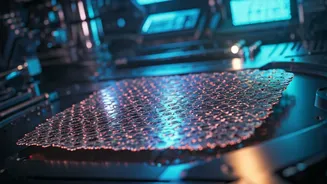
This innovative technique reworks the traditional chemical vapor deposition process. By integrating a liquid gold and tungsten bilayer as the foundation, the researchers have unlocked the ability to grow monolayer tungsten silicon nitride films with precisely controllable doping characteristics. This breakthrough moves beyond incremental improvements, offering a substantial leap in production speed and material quality, potentially enabling the widespread adoption of these advanced materials in next-generation computing devices. The implications for overcoming current technological hurdles are profound, promising to unlock new frontiers in processing power and efficiency for demanding applications.
The 2D Semiconductor Advantage
For decades, the relentless progress predicted by Moore's Law has been the driving force behind computing advancements, but we're now encountering fundamental limits. As transistors shrink to atomic dimensions, quantum phenomena and heat management become increasingly problematic, hindering further miniaturization. This is where 2D semiconductors emerge as a beacon of hope for post-Moore chip designs. With the ever-increasing demands of AI and complex computational tasks pushing existing chip architectures to their breaking point, the unique properties of 2D materials offer a promising avenue for innovation. Their inherent thinness and distinct electrical characteristics present solutions to the escalating challenges of miniaturization and performance.
Bridging the P-Type Material Gap
Modern chip architecture heavily relies on the complementary integration of both n-type and p-type semiconductor materials. However, a significant constraint has emerged in the form of a shortage of high-performance p-type options. While many n-type 2D semiconductors have been successfully developed, achieving stable and effective p-type counterparts has proven to be a persistent challenge. This scarcity acts as a major roadblock for the design of next-generation chips, particularly those aiming for sub-5 nanometer nodes. The development of robust p-type 2D semiconductors is therefore a critical area of research, essential for unlocking the full potential of advanced transistor designs and meeting the burgeoning computational needs of the modern digital landscape.
Tungsten Nitride Film Benefits
The monolayer tungsten silicon nitride films developed through this new process offer a compelling combination of attributes essential for cutting-edge transistor design. These films exhibit remarkable hole mobility, a crucial factor for efficient current flow, and boast a high on-state current density, enabling more powerful and responsive circuits. Furthermore, their inherent mechanical strength, coupled with effective heat dissipation capabilities and chemical stability, ensures durability and reliability in demanding environments. The production speed has been dramatically enhanced, progressing from a mere 0.00004 inches over five hours to approximately 0.0008 inches each minute, signifying an impressive acceleration of around 1,000x compared to prior methodologies. This leap in efficiency could drastically reduce manufacturing times and costs.
Path to Mass Production
While this research signifies a remarkable stride in 2D semiconductor fabrication, bridging the gap between laboratory-scale centimeter films and mass-produced defect-free wafers remains a substantial hurdle. The current gold-based substrate, although effective for research purposes, presents a prohibitive cost barrier for high-volume manufacturing. China's ambition to overcome existing semiconductor limitations is evident, and this study represents a significant breakthrough in that pursuit. However, the history of the semiconductor industry is marked by promising 2D materials that failed to transition from academic publications to large-scale industrial production. The ultimate success of this particular material will hinge on effectively addressing the persistent challenges of scalability and cost that have previously hindered similar advancements.