






The King of Fruits
The mango holds a special place in Indian culture and economy, often called the 'king of fruits.' India's dominance in mango production is undeniable,
accounting for nearly half of the world's output, with over 20 million metric tonnes harvested annually. This vital crop significantly contributes to the nation's agricultural gross domestic product and provides employment for a substantial portion of the agricultural workforce. The export market alone is worth over USD 860 million, underscoring the deep connection between mango cultivation, rural prosperity, and overall food security in India. Despite this immense success, the traditional methods of growing mangoes are facing increasing pressure from a changing environment and market dynamics, necessitating innovative solutions to sustain this important industry.
Facing Modern Threats
Traditional mango farming, heavily reliant on the farmer's intuition and experience, is struggling to cope with the unpredictable nature of modern agricultural challenges. Climate variability, leading to erratic weather patterns, and the increasing prevalence of pests and diseases are severely impacting crop yields. Common ailments like anthracnose, powdery mildew, and bacterial spot manifest as dark lesions, powdery coatings, or water-logged patches on the fruit and leaves. The delayed identification of these symptoms often results in significant financial losses for farmers, affecting their entire season's harvest. Current inspection techniques, while valuable, are time-consuming and subjective, making it difficult to consistently monitor vast orchards for early signs of trouble. Farmers require a blend of their ingrained knowledge with advanced precision and speed to combat these growing threats effectively.
Intelligent Farming Takes Root
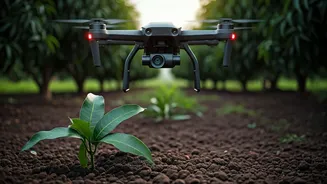
Artificial Intelligence is emerging as a powerful ally for mango farmers, acting as an augmented vision system to enhance traditional practices. Across India's mango-growing regions, including those near Chennai, AI-powered systems are beginning to refine decision-making processes that were once based on educated guesses. Sophisticated weather models analyze extensive historical and real-time data to accurately predict changes in rainfall and temperature. Complementing this, networks of soil sensors continuously transmit vital information about nutrient content and moisture levels. This integrated approach allows farms to proactively adapt to conditions rather than merely reacting to them. Furthermore, drones equipped with advanced AI imaging capabilities are now regularly surveying orchards from above, capturing high-resolution visual and infrared data to detect plant stress long before it's perceptible to the human eye.
Precision in Practice
AI's impact extends to meticulous management of crucial resources like water and soil. Drones with AI capabilities can identify subtle stress indicators in trees, such as variations in leaf temperature or early pest infestations, which might go unnoticed by human observation. This early detection is critical for minimizing the need for broad-spectrum pesticide applications, allowing for more targeted, efficient, and timely interventions. Image recognition tools powered by AI are also revolutionizing disease diagnosis. By analyzing images of leaves and fruits, machine learning models trained on specific disease patterns can alert farmers to infections at their nascent stages, providing recommendations on the appropriate treatments, dosages, and timing. This paradigm shift from reactive treatment to proactive prevention is demonstrably reducing crop losses and enhancing the overall quality of the mangoes harvested. Similarly, AI-driven irrigation systems, which integrate data from soil moisture sensors with weather forecasts, ensure that trees receive the exact amount of water they need, optimizing usage in water-scarce regions. For soil health, AI sensors monitor pH, nutrient balance, and moisture, providing farmers with precise fertilization recommendations, which in turn reduces chemical overuse, cuts costs, and promotes long-term soil vitality.
Beyond the Harvest
The influence of AI in mango cultivation doesn't cease once the fruit is picked; it continues through the post-harvest stages to optimize market readiness and reduce waste. Advanced AI-powered sorting and grading systems are now employed to classify mangoes with high accuracy based on their size, shape, and ripeness. This ensures a consistent quality standard in the market, leading to better price realization for the farmers. Furthermore, AI plays a role in storage management by monitoring environmental conditions to minimize spoilage and in logistics by optimizing transportation routes for efficient delivery. These integrated AI applications contribute to a more streamlined and profitable supply chain, minimizing losses from farm to consumer and maximizing the economic benefits derived from India's abundant mango production.