





Celestial Spectacle Approaches
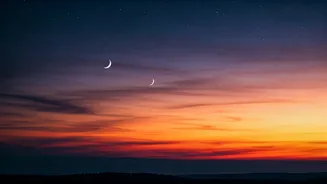
On the evening of March 26, 2026, skywatchers are in for a treat as the moon and the colossal planet Jupiter embark on a stunning visual journey across
the twilight sky. This conjunction promises a beautiful spectacle, particularly for those equipped with telescopes. A modest 6-inch telescope, for instance, will allow observers to delve into the intricate details of the lunar surface, revealing its shadowed seas and prominent craters along the terminator – the line dividing day and night. Simultaneously, Jupiter's distinctive cloud bands and its four largest moons will become discernible, offering a glimpse into the gas giant's dynamic atmosphere. This alignment offers a fantastic opportunity to appreciate the scale and beauty of our solar system from our own planet.
Viewing the Cosmic Duo
For those eager to witness this celestial ballet, the best viewing window will be shortly after sunset on March 26, 2026. Look towards the east, where the waxing gibbous moon will be prominently visible, shining in close proximity to Jupiter. The moon will appear with its right side illuminated by sunlight, a characteristic feature less than a day after it achieved its first quarter phase. Jupiter itself will present as a brilliant, star-like object, positioned about five degrees to the lower right of the lunar disk – a distance roughly equivalent to the span of three middle fingers held at arm's length. Accompanying this pair, high and to the upper right, you'll notice Castor and Pollux, the two principal stars of the constellation Gemini, adding to the celestial tapestry.
Jupiter's Spring Presence
Jupiter's visibility in the spring sky extends well into July, captivating astronomers and casual observers alike. It will remain a prominent fixture until mid-July when its proximity to the setting sun will gradually render it invisible. This period culminates in Jupiter's solar conjunction on July 29, a time when the planet will be too closely aligned with the sun from Earth's perspective to be seen. Throughout its spring tenure, Jupiter serves as a beacon, inviting exploration and encouraging deeper engagement with the wonders of our solar system. Observing its journey alongside the moon provides a dynamic perspective on planetary motion and celestial mechanics.