






Nature's Hollow Advantage
Nature rarely relies on solid mass for structural integrity; instead, it cleverly employs porous designs to maximize strength while minimizing weight.
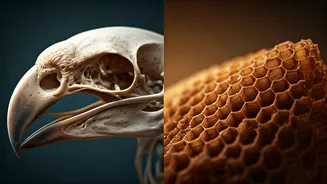
Consider a bird's bone: it's not solid but a sophisticated, sponge-like network of struts and voids. This intricate internal architecture, filled with empty space, grants a bird's wing the resilience to withstand powerful winds during flight, all while remaining exceptionally light. This principle of efficient material use is evident across the natural world, from the hexagonal precision of a honeycomb, which optimizes wax usage for honey storage, to the spiraling internal structures within seashells that provide remarkable resistance to crushing forces. For ages, human engineers have admired this natural engineering prowess, yearning to replicate it in manufactured goods. However, historical manufacturing techniques, primarily subtractive methods like carving or injection molding, presented significant limitations in creating such complex, internal, void-filled geometries. These methods often resulted in heavier, less efficient products that demanded more energy for their creation and transportation.
The Rise of Mesostructures
The advent and widespread adoption of additive manufacturing, commonly known as 3D printing, has revolutionized our ability to mimic nature's lightweight, strong designs. This technology fundamentally differs from traditional methods; instead of removing material from a solid block, 3D printers meticulously build objects layer by layer, depositing material precisely where it's needed according to a digital blueprint. This additive process has opened up a new realm in materials science focused on 'mesostructures.' A mesostructure represents an intermediate level of organization, sitting between the atomic scale of a material's composition and the macroscopic form of an entire object. It's the intricate internal arrangement of material and empty space that dictates an object's properties. Think of it as the difference between a solid brick and the elaborate iron framework of the Eiffel Tower; both are robust, but the latticed tower achieves its strength with significantly less material due to the strategic distribution of voids.
Bio-Inspired Products Emerge
While the exploration of additive manufacturing for creating mesostructure-rich parts initially found traction in high-demand sectors like aerospace and medical devices, these bio-inspired designs are increasingly appearing in everyday consumer goods. The footwear industry serves as a prominent illustration. Examine the soles of many modern running shoes, and you'll notice they aren't uniformly solid foam. Instead, they often feature complex, interwoven lattice structures that bear a striking resemblance to the internal structure of a bird's bone. This 3D-printed construction thoughtfully mimics the springiness and weight distribution characteristics found in natural porous systems, offering a level of performance tuning that solid foam simply cannot achieve. The same design philosophy is being applied to enhance safety equipment. For instance, the liners of advanced helmets, including those for sports like football, are beginning to incorporate 3D-printed lattices instead of traditional foam padding. These tiny, intricate lattice networks are engineered to deform and recover efficiently, absorbing impact energy far more effectively than solid materials, much like the porous bone structure in a skull protects the brain.
Decoding Nature's Rules
My research delves into the fundamental principles that govern nature's robust structural designs, seeking to understand the rules of efficient building. For instance, the toughness of nacre, or mother-of-pearl, stems from its brick-like construction: hard mineral plates are bound by a flexible, adhesive layer. This arrangement allows the plates to slide against each other under stress, preventing catastrophic fracture and enabling the shell to absorb and dissipate energy, thus stopping cracks from propagating. To unravel these principles, I employ computational simulations, subjecting thousands of virtual designs to simulated crushing forces to pinpoint their failure points and mechanisms. Furthermore, I've utilized machine learning algorithms, a form of artificial intelligence, to discover optimal patterns for energy absorption. My findings consistently highlight the effectiveness of wave-like designs, particularly when the thickness of the structural elements and the curvature of the patterns are precisely calibrated. Identifying these optimal configurations allows for the creation of products that exhibit gradual and predictable failure modes, enhancing safety and reliability, akin to the crumple zones found at the front of vehicles. By grasping the mechanics of these naturally inspired structures, engineers can precisely tailor them for specific functions, engineering stiffness in one area and flexibility in another, all within a single, continuous 3D-printed component.
A Sustainable Tomorrow
Beyond the enhanced performance characteristics, adopting nature's 'less is more' philosophy through the incorporation of internal voids presents a significant advantage for environmental sustainability. By strategically 'printing air' into the internal framework of a product, manufacturers can dramatically reduce the amount of raw material consumed while still achieving the necessary structural strength and integrity. As industrial 3D printing technologies continue to evolve, becoming more accessible and cost-effective, the manufacturing landscape is set to shift decisively away from the era of solid, monolithic construction. We are moving towards embracing the elegant, resource-efficient principles exemplified by the biological world. Nature has, over millions of years of evolution, perfected these intricate designs, and engineers are now finally gaining the knowledge and tools to decipher and implement them.