







The AI Slop Phenomenon
Social media platforms like Instagram Reels and YouTube Shorts are currently awash with bizarre, AI-generated short videos. These often feature personified
food items or animals caught in dramatic, often toxic, relationships. You might see anthropomorphic fruits engaged in infidelity, vegetables grappling with abandonment issues, or familiar Indian snacks like rajma and chawal involved in complicated love triangles. These clips, characterized by their slightly uncanny visuals and overly emotional narratives, often feature swelling background music and characters exhibiting surprisingly human expressions. The content is designed to be instantly attention-grabbing, creating a compelling loop where viewers find themselves passively, yet curiously, invested in these highly dramatized, low-fidelity stories that appear to have taken over feeds without explicit searching.
Defining AI Slop
The term "AI slop" broadly refers to content that is mass-produced with the assistance of artificial intelligence tools, prioritizing quantity and immediate engagement over substantive quality or originality. This content can manifest as text, images, or videos, and is typically generated with minimal human creative input. Its defining characteristic is an illusion of polish that masks repetitive, formulaic, and often nonsensical underlying structures. These creations are engineered to be easily digestible and highly shareable, frequently employing glitches, exaggerated emotional displays, and plots that escalate rapidly due to the algorithms' propensity to reward intensity. This ease of production and consumption makes it a pervasive force, difficult to ignore once encountered.
Viral AI Narratives
The AI slop trend has spawned numerous viral sensations. One prominent example is "Fruit Love Island," an AI-generated series featuring anthropomorphic fruits like Bananito and Strawberina navigating romantic entanglements and eliminations reminiscent of reality dating shows. This series garnered millions of followers and immense viewership. Prior to this, simpler, emotionally charged narratives involving talking objects gained traction, such as a chicken nugget lamenting separation from its mother, a broccoli parent abandoning its child, or a citrus fruit disowning its offspring, each story striving for greater dramatic impact than the last.
The Indian Slop Universe
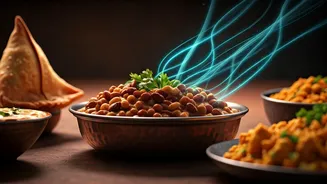
Indian content creators have effectively localized the AI slop trend, infusing it with culturally relevant themes and familiar food items. Instead of generic fruits, we now see heart-wrenching breakups between rajma and chawal, arranged marriages involving chai and Parle-G biscuits, and love triangles featuring pav and vada. This localization transforms the inherent absurdity into something relatable, turning a fleeting joke into a compelling narrative. This blend of the familiar with the bizarre is a key reason for its popularity among younger Indian audiences, who are drawn to stories that echo the dramatic storytelling they've grown up with, mirroring the exaggerated emotional arcs found in traditional Indian television.
Why Indians Love AI Slop
The widespread appeal of AI slop in India can be attributed to several factors. Firstly, audiences are conditioned by decades of high-drama television serials, characterized by betrayal, family feuds, and supernatural elements, making them receptive to exaggerated narratives. Secondly, these videos exploit fundamental human emotional triggers like love, betrayal, and family honor, delivering these intense emotions in short, easily digestible bursts. Accessibility is also crucial; the low barrier to entry allows virtually anyone with a smartphone to create such content, democratizing production but also contributing to content saturation. Finally, the algorithms themselves play a significant role, rewarding any form of engagement, regardless of content quality, thereby perpetuating the cycle of viral AI slop.
The Darker Side of Slop
Despite its seemingly harmless and absurd entertainment value, AI slop harbors concerning underlying issues. Many narratives perpetuate regressive social tropes, often portraying women as manipulative or materialistic and men as victims or moral arbiters. Themes of purity, honor, and control are frequently woven into the plots, disguised as mere 'drama,' with misogyny often embedded due to its effectiveness in driving engagement. Furthermore, these videos casually incorporate troubling themes such as homophobia, body shaming, and even hints of abuse as plot devices, often without any critical nuance or accountability. This normalization of problematic narratives, coupled with the engineered emotional manipulation, could pave the way for more malicious uses of similar AI storytelling formats, including misinformation and propaganda.