






A Breakfast Paradox
Every city boasts its signature morning meal, from Mumbai's vada pav to Delhi's chole bhature. Yet, nestled in the heart of India, specifically in the vibrant,
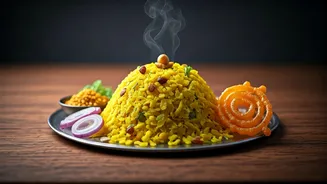
food-centric metropolises of Indore and Bhopal, lies a breakfast that defies convention. It's a duality: one part is light and savory, the other, sticky, sweet, and glistening. Individually, they seem disparate, but together on a plate, they achieve a remarkable harmony. This poha-jalebi combination is more than just a meal; it’s a daily ritual, a cultural emblem, and a piece of history that most have come to cherish without a second thought. The genesis of this beloved pairing is often attributed to Indore, though Bhopal also lays a strong claim, with the entire Malwa region holding it dear to its culinary heart.
Maratha Roots Blossom
The story of Indori poha, a celebrated flattened rice delicacy, is deeply intertwined with the city of Indore itself. Its origins are believed to date back to the period following India's independence. However, poha didn't emerge in a vacuum. To truly grasp its significance, one must understand the historical trajectory of Indore. Founded as a crucial trading post connecting the Deccan and Delhi in the 16th century, the city's destiny was further shaped when it came under the Maratha Empire on May 18, 1724. It is this Maratha influence that brings poha into the narrative. Rulers like the Holkars and Scindias, who migrated from Maharashtra where poha is a popular dish, introduced their culinary traditions to Madhya Pradesh. Wherever these Maratha rulers established their domain, familiar dishes such as shrikhand and poha began to take hold, suggesting a culinary migration where ruling dynasties brought their food habits, cooks, and ingredients, allowing these flavors to flourish in new lands.
Indori Poha's Unique Steam
While poha is a popular dish found across India, with distinct versions in Maharashtra, Gujarat, and other states, the preparation method in Indore sets it apart. Unlike the commonly pan-cooked poha, Indori poha is uniquely steamed. This technique imparts a distinct taste, exceptional softness, and a nuanced flavor profile. The process begins with seasoning washed flattened rice, followed by pouring a tempering over it, and then steaming the mixture. The result is a dish that is both lighter and fluffier than its counterparts. The flavor of Indori poha is further enhanced by the subtle addition of fennel seeds, lending a fragrant sweetness. It's typically topped with sev or bhujiya, a crunchy snack made from gram flour and spices. While Maharashtrian poha often incorporates coconut, coriander, potatoes, and onions, Indore's variation from the Nimar-Malwa region is garnished with crushed kachori, bhujia sev, and often, jalebis, creating a multi-layered culinary experience.
Garnishes and Spices
The garnishes adorning Indori poha are a crucial element, elevating the dish beyond a simple snack. A delightful array often includes jalebi, sev, usal, thinly sliced onions, and fennel seeds. A signature touch is the dash of Jeerawan powder, a proprietary spice blend unique to Indore and comprising about 20 different spices. This special mix is integral to the region's culinary identity and distinct from generic chaat masala. The significance of Indori poha was further cemented in 2017 when India Post released a commemorative stamp in its honor, recognizing its status as a cherished traditional dish. The inclusion of jalebi, a sweet component, in this breakfast combination is not arbitrary but rather a historical fusion, reflecting a deeper culinary evolution that has taken root in the region.
Jalebi's Ancient Journey
The sweet and syrupy jalebi, a key partner in this breakfast pairing, boasts a history stretching back to the Middle East, where it was known as Zalabiya. Initially prepared by frying a fermented wheat batter and then soaking it in honey or sugar syrup, this confection finds mention in ancient Arabic cookbooks, including the 10th-century 'Kitab al-Tabikh' and works by Muhammad bin Hasan al-Baghdadi in the 13th century. Turkish and Persian traders introduced Zalabiya to India, where it gradually evolved into the jalebi we recognize today. By the 15th century, it had become a cultural staple, integral to festivals, weddings, and temple rituals. The earliest recorded mention of jalebi in India appears in the 1450 CE Jain text 'Priyamkarnrpakatha' by Jinasura, where it's noted as part of a merchant's dinner. This suggests jalebi has been a part of Indian cuisine for at least six centuries. By the time it reached Madhya Pradesh, it had traversed through Persian kitchens, Turkish trade routes, and Mughal courts, absorbing influences along its journey.
A Cultural Confluence
While Bhopal is celebrated for its Mughal-influenced delicacies like shahi tukda and kebabs, the pairing of jalebi with poha showcases a unique cultural blend that defines central India. This breakfast combination elegantly encapsulates the region's diverse cultural geography. One component, poha, carries the legacy of Maratha rulers from Maharashtra, while the other, jalebi, reflects Persian and Mughal influences. Both traditions converge harmoniously in Madhya Pradesh. Food combinations persist and thrive when they resonate with the local palate, and poha-jalebi achieves this in a profoundly authentic, local manner. It has become the quintessential breakfast of the Malwa region, a testament to how two disparate dishes can create a beloved, successful pairing. Indore's culinary landscape, in particular, is a rich tapestry woven from Maharashtrian, Malwi, Rajasthani, and Gujarati influences, which explains why this particular combination makes such delicious sense here.
The Malwa Palate's Appeal
The reason poha-jalebi works so well within the Malwa region lies in its established palate, which is accustomed to a delightful interplay of contrasting flavors and textures. The sour tang of the poha, with its savory notes, finds a perfect counterpoint in the syrupy sweetness of the jalebi. This is not an unusual pairing in this context; rather, it's the natural culmination of a food culture that thrives on layered, complex flavors. The Malwa palate is adept at appreciating a spectrum of tastes, from sweet and sour to spicy and cooling, and from crunchy to soft. The juxtaposition of the fluffy, tangy poha with the crisp, sweet jalebi embodies this culinary philosophy. It's the kind of balanced contrast that makes the combination so satisfying and deeply ingrained in the daily lives of the region's inhabitants, reflecting a sophisticated understanding of flavor dynamics.
Street Vendors and Identity
In Indore, the morning streetscape is incomplete without vendors skillfully preparing and serving poha-jalebi. These vendors are often found alongside other popular local snacks like kachori and samosas. The street vendor culture in Indore is taken with utmost seriousness; it's a city that imbues its food identity with personal pride. The poha-jalebi cart is as much a part of this identity as iconic locations like the old Sarafa Bazaar and Chappan Dukan. While sit-down restaurants now offer their versions of this breakfast, and some are quite commendable, the authentic experience is best savored by standing at a street cart, paper plate in hand, with the sweet syrup of the jalebi just threatening to drip down your wrist. This immersive experience connects diners directly to the city's vibrant culinary heritage and its deeply rooted street food traditions.
Pursuit of GI Tag
The culinary significance of Indori poha has garnered official recognition and is currently part of an effort to secure a Geographical Indication (GI) tag. In 2019, the Indore Mithai Aur Namkeen-Vikreta Vyapari Sangh (IMANVVS), an association representing sweets and snacks manufacturers, began documenting four prominent food items from the Malwa region, including Indori poha. The goal is to gain official protected status for these traditional foods. If successful, Indori poha-jalebi would join an exclusive roster of Indian breakfast dishes holding GI recognition. This endeavor underscores the dish's deep cultural importance and its unique identity, making it a fitting candidate for such esteemed status, given the rich history and tradition it represents.
Bhopal's Tangy Take
Bhopal's connection to poha-jalebi, while sharing similarities with Indore, presents a distinct flavor profile and experience. Residents often queue up for their morning meal even as vendors are in the process of setting up their stalls. The jalebis here are noted for their crispiness and juicy texture, complemented by a tangy and spicy poha. Bhopal's version tends to lean more towards the spicier side, influenced by the city's Mughal heritage, and often features a slightly different array of garnishes. Despite the cities being only a couple of hours apart, their poha dishes possess enough unique characteristics that regulars can readily identify and express their preference for one over the other. This subtle divergence highlights how the same core ingredients can be interpreted differently, reflecting the specific culinary narratives of each city.
Authenticity in Diversity
The beauty of the poha-jalebi combination lies in its adaptability and the fact that neither Indore nor Bhopal's interpretation is inherently superior; both are authentic. The dish's essence is its capacity to absorb and reflect the local culture wherever it settles, resulting in a taste that is distinctly representative of that place. The fennel-forward, sev-heavy Indori version and the tangier, spicier Bhopali iteration both stand as valid embodiments of the dish. They are not competing versions but rather distinct conversations happening between the same set of ingredients and two unique urban environments. This diversity in authenticity is what makes the poha-jalebi experience so rich and compelling, showcasing the nuanced evolution of a beloved breakfast staple.
A Daily Ritual's Legacy
To savor poha-jalebi in Indore or Bhopal is to partake in a meal that has been shaped by a confluence of historical forces: Maratha migrations, Persian trade routes, Mughal kitchens, and the unique ingenuity of a food culture adept at transforming external influences into something entirely its own. This is not a fleeting trend, nor a dish reserved for special occasions or food festivals. Instead, it is a steadfast, daily morning meal, consistently enjoyed on the same streets, from similar vendor carts, for generations. The combination, which might seem illogical at first glance, is precisely the kind that, once experienced, leaves an indelible mark, prompting a lifelong search for its authentic taste, a quest that rarely yields a satisfactory substitute elsewhere. It represents a deep connection to place and tradition.