



Limitations of Current Prosthetics
Traditional prosthetic limbs, despite advancements in appearance and movement, fall short in practical, kinetic environments due to a fundamental lack
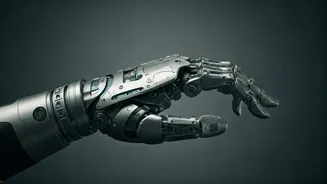
of sensory feedback. These devices operate on a one-way communication system: the user flexes a muscle, and the limb responds. However, there's no return signal. Unlike natural limbs, which provide constant proprioception—the awareness of limb position and grip strength—current prosthetics require constant visual confirmation. For instance, a soldier must visually check if they are securely holding a rifle magazine or a tourniquet, a demand that diverts critical attention away from situational awareness during combat. This visual burden often leads amputees to prefer simpler, less cognitively demanding tools like hooks over complex robotic arms. The high cognitive load associated with managing non-sensory prosthetics renders them a liability in high-stakes scenarios, significantly hindering performance and increasing risk for both the individual and their unit. This reliance on sight for grip confirmation is a critical vulnerability that the NEPH system aims to overcome.
The NEPH System Explained
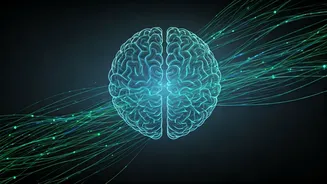
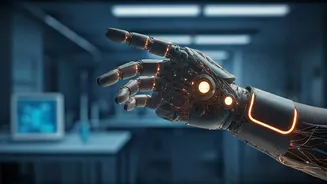
The Neural-Enabled Prosthetic Hand (NEPH) system ingeniously overcomes the sensory feedback gap by establishing a direct conduit between the prosthetic and the user's nervous system. Developed by leading researchers, this technology moves beyond the realm of science fiction by employing a hard-wired interface. At its core, a surgeon implants a neurostimulator, akin to a pacemaker, into the amputee's upper arm. Thin wires, known as microfilaments, are then carefully threaded into the median and ulnar nerves, pathways that historically transmitted sensory data from the hand to the brain. This intricate setup creates a neural bridge. The NEPH itself is equipped with sophisticated sensors embedded in its fingertips and palm, capable of detecting nuances like grip force and hand aperture. When the user engages with an object, these sensors transmit this data to the implanted neurostimulator. The stimulator then translates the digital information into precise electrical pulses, which are delivered to the nerve fibers. Consequently, the brain receives signals mirroring those it would have received from a biological hand, allowing the user to perceive the sensation of touch, pressure, and grip strength without relying on visual cues.
Psychological Restoration Through Touch
Beyond its tactical advantages, the NEPH system offers profound psychological benefits for amputee soldiers, addressing the persistent issue of phantom limb sensations. Many amputees experience a 'phantom limb,' a persistent feeling that the missing limb is still present, often in a distorted or painful state. This phenomenon arises from the brain's continued attempts to receive sensory data from the absent limb, leading to frustration and anxiety. The NEPH effectively alleviates this by re-establishing a genuine sensory connection. As the brain begins to receive valid signals from the nerves via the prosthetic, it gradually accepts the artificial limb as an extension of the self, rather than an external object. Clinical trials have documented instances where participants reported their phantom limbs 'extending' to occupy the space of the prosthetic. Experiencing the texture of a pillow or the sensation of holding a loved one’s hand, even through a prosthetic, is incredibly powerful. This reintegration is crucial for a soldier's recovery, fostering acceptance and encouraging greater engagement with rehabilitation and training.
Future of Human-Machine Synergy
The NEPH represents not just an advancement in prosthetics but a significant step towards a future of profound human-machine integration. It serves as a compelling proof of concept for technologies that can directly interface with the human nervous system. If touch can be restored to a prosthetic hand, the possibilities expand dramatically. Consider applications where individuals might 'feel' the operational feedback of complex systems – a drone operator sensing atmospheric conditions or a bomb disposal technician identifying chemical compositions through tactile input. This technology transforms a disability into a unique capability, offering soldiers a pathway to regaining not just function but enhanced interaction with their environment and tools. The vision moves beyond prosthetics to a broader era where humans and machines collaborate as true partners, blurring the lines between biological and artificial systems and unlocking unprecedented potential.