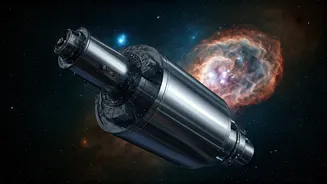

Telescope Technology Unveiled
2026 will showcase an array of cutting-edge telescope technologies. NASA is set to unveil the next-generation Roman Space Telescope, fully assembled and
potentially launching earlier than anticipated. Simultaneously, former Google CEO is spearheading the development of four next-generation telescopes, with three based on Earth and one in space. Furthermore, the world will see the potential of superheavy-lift rockets, such as SpaceX's Starship, which could significantly reduce the costs of deploying space telescopes, thereby revolutionizing the field of astronomy. Private missions aim to rescue NASA's space telescope, which is expected to launch in 2026 on a rocket that will be dropped from a plane. These advancements signal a pivotal shift towards more affordable and accessible astronomical observation, providing an unprecedented opportunity to discover more about our universe.
Lunar Landings and Missions
The year 2026 will be a landmark year for lunar exploration. Multiple private spacecraft are gearing up for lunar landings, marking a surge in private sector involvement in space exploration. These missions will test new technologies and pave the way for future lunar bases and resource utilization. In addition to lunar landings, there will be a focus on Mars sample return missions. Experts emphasize that returning samples from Mars before China should be a top priority for the United States. This highlights a competitive race to unlock the secrets of the red planet and potentially reveal signs of past or present life. These missions underscore the growing global interest in understanding and potentially colonizing other celestial bodies.
Exoplanet Discoveries Explored
2026 promises exciting new discoveries in exoplanet research, with scientists modeling stars to find habitable exoplanets within the TRAPPIST-1 system. Additionally, NASA's Pandora exoplanet mission, along with several other satellites, will be launched by SpaceX to enhance the search for planets outside our solar system. The year will also feature the deployment of technology that could potentially identify the stars around habitable exoplanets, which in turn could potentially confirm the existence of alien life. Further, scientists are working on detecting life without knowing its exact form, employing machine learning techniques to search for biosignatures. These efforts represent a multi-pronged approach to find life beyond Earth and broaden the scope of astronomical research.
Astronomy’s Super Bowl
The year will feature major astronomical events and discoveries. The ‘Super Bowl of Astronomy’ will commence, marking a period of intense activity and announcements in the field. This event is expected to reveal critical insights and findings from ongoing research. Besides this, astronomers will continue to study a ‘mysterious disruptor’ with a mass of 1 million suns and a black hole at its center, with the goal of understanding the origins and behaviors of celestial anomalies. The focus will be on the study of interstellar comets, which, in 2025, confirmed that they were not alien spacecraft. These events promise to enhance our understanding of the universe, and the mysteries contained within.