







Explosive 5G Growth
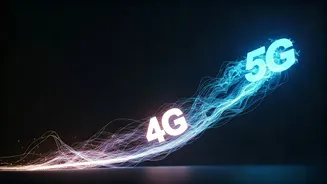
India's mobile data landscape is undergoing a seismic shift, evidenced by a remarkable 70% year-on-year increase in 5G data traffic. This significant surge
has propelled 5G usage to levels nearly matching that of 4G, signifying accelerated adoption across the nation. In 2025, monthly 5G traffic reached an impressive 12.9 Exabytes (EB), constituting approximately 47% of all mobile broadband traffic. Experts anticipate that 5G's dominance over 4G traffic is imminent, potentially occurring within the next one to two quarters. This rapid expansion is occurring even though network operators still possess substantial untapped capacity, with 5G utilization typically ranging between 30% and 60%. This suggests that further traffic growth can be accommodated without immediate, large-scale infrastructure overhauls. The average monthly data consumption per user now stands at around 31 GB, reflecting an 18% compound annual growth rate over the past five years. The total data traffic in 2025 surpassed 27 EB per month, fueled by the swift rollout of 5G, the availability of affordable smartphones, and escalating consumption of video content, social media, and AI-driven applications.
Uniform National Adoption
Contrary to initial expectations that 5G adoption would remain concentrated in major metropolitan areas, the latest data reveals a much broader and more uniform uptake across India. While leading metropolitan markets currently account for 58% of the total 5G traffic, adoption rates in Category A, B, and C circles are rapidly converging. This trend signifies a narrowing of the digital divide and indicates that the benefits of 5G technology are becoming accessible to a more diverse population across the country, not just urban centers. This widespread adoption across different tiers of cities suggests a robust and equitable expansion of advanced mobile broadband services throughout India, contributing to a more connected nation.
Subscriber and FWA Growth
India has solidified its position as a global leader in the 5G ecosystem, ranking as the second-largest market worldwide for both 5G subscribers and data consumption. Furthermore, the country is making significant strides in Fixed Wireless Access (FWA), a technology that leverages 5G to provide high-speed broadband internet to homes and businesses wirelessly. The report projects an astounding growth trajectory for India's 5G subscriber base, with estimates suggesting it could surpass 1 billion by the year 2031. This exponential increase highlights the immense potential and widespread appeal of 5G technology within the Indian market. The FWA segment, in particular, is emerging as a crucial driver of traffic growth, accounting for over 25% of all 5G data. Users engaging with FWA services are consuming substantially more data compared to typical mobile users, nearly ten times as much, underscoring its importance in shaping future data consumption patterns.
Consumer vs. Enterprise Use
The current surge in data usage across India is predominantly fueled by consumer-oriented applications, with video streaming and social media platforms being the primary drivers. While enterprise use cases are still in their nascent stages globally, they are expected to play an increasingly significant role in the future. As mobile networks evolve, artificial intelligence (AI) is poised to reshape network behavior. Presently, mobile networks are heavily optimized for downloads, with traffic skewed around 90% downlink to 10% uplink. However, the rise of AI, content creation, and multimodal applications is expected to drive a significant increase in uplink demand, potentially shifting this balance. To accommodate these evolving traffic patterns, network operators will likely need to implement dynamic spectrum usage strategies. The device ecosystem is also rapidly adapting, with over 90% of smartphones shipped in 2025 being 5G-capable, and more than 383 million devices already supporting the technology, further accelerating the transition to next-generation mobile services.
Future Growth Avenues
Beyond smartphones and core mobile services, a diverse array of connected devices is set to contribute substantially to future data growth. This includes an expanding ecosystem of wearables, smart home appliances, electric vehicles, and industrial Internet of Things (IoT) systems, all of which will generate and consume increasing amounts of data. Furthermore, the proliferation of on-device and cloud-based AI workloads, requiring enhanced processing power and memory capabilities, will also be a significant contributor to data traffic. Despite this robust data growth, a critical challenge remains in re-evaluating monetization strategies. Industry executives note that the average revenue per user (ARPU) remains relatively low. While enterprise 5G use cases are widely viewed as a key revenue driver, their global adoption is still in the early phases. Therefore, finding sustainable and profitable business models for 5G services will be paramount for continued investment and innovation in the sector.