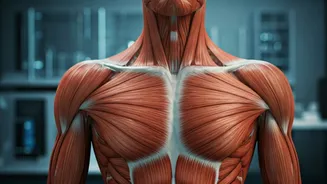








Muscle-Powered Machines
The field of robotics is undergoing a fascinating transformation with the development of biohybrid robots. These machines are not powered by conventional
motors or batteries, but by actual muscle tissue. Researchers have successfully incorporated lab-grown muscle strips into robot designs, creating a more organic and efficient system. The core concept involves a 'muscle-tendon unit,' where a small piece of lab-grown muscle is connected to artificial, rubber band-like tendons. This mimics the natural structure of muscle and tendon in living organisms. When stimulated, the muscle contracts, pulling on the tendons and generating movement. This innovative approach promises to revolutionize robotics by creating robots that can move and function more like biological systems.
Creating the MTU
A critical aspect of these biohybrid robots is the 'muscle-tendon unit' (MTU). The MTU is the fundamental building block of this technology. It is composed of a piece of lab-grown muscle attached to artificial tendons. The engineers meticulously attached these rubber band-like tendons to each end of a small piece of muscle. These artificial tendons are designed to mimic the function of natural tendons, which transmit force from the muscle to the bones, enabling movement. The MTU design is important because it allows the muscle to contract, pulling on the tendons, and thus generating the necessary force for movement. This creates a functional unit capable of producing mechanical action. Scientists are continually refining the design and materials used in both the muscle and tendon components, seeking to improve efficiency and durability.
Mimicking Biology
The genius behind biohybrid robots lies in the attempt to mimic biological systems. In a native muscle-tendon-bone architecture, muscle contraction generates movement across an articulating joint. The biohybrid MTUs are designed to function similarly. The artificial tendons are crucial here, enabling the force generated by the muscle to be transferred effectively. These robots attempt to replicate the natural movement mechanisms seen in living creatures. By closely observing and replicating the way muscles, tendons, and bones work together in nature, engineers aim to build robots that can perform complex movements, potentially opening up a wide array of new applications. This also allows the robot to be more adaptable to various environments.
Testing the MTUs
To understand how the biohybrid MTUs perform, researchers use different testing methods. One key method involves using an optical stimulation apparatus, which allows them to observe and control the movement of the muscle-tendon units. They're also using custom incubation apparatuses, especially for temperature-controlled fatigue testing of the MTUs. These tests are essential for studying the performance of the muscle-tendon units under different conditions. The research teams assess how long the MTUs last, how much force they can generate, and how efficiently they convert energy into movement. The gathered data helps refine the design and the materials involved. Continuous testing allows engineers to improve the durability and overall effectiveness of the biohybrid robots.
Flexure Skeleton
The flexure skeleton, often mounted on a rigid base, plays a vital role in integrating the muscle-tendon units into the overall robot structure. This allows researchers to study the movement characteristics. Biohybrid MTUs, comprising a muscle strip connected to a tendon hydrogel at both ends, are mounted onto the pins of the flexure skeleton. This allows for a structured and controlled environment in which to test the MTUs. The flexure skeleton provides the framework within which the muscle contraction can generate movement. The flexure skeleton and the MTUs create a functional structure that is used to assess, and learn about biohybrid robot behavior.