





Sticky Footed Geckos
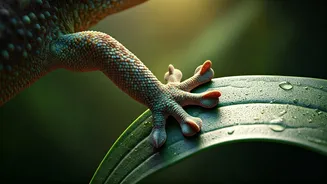
Geckos, those fascinating little reptiles, possess an uncanny ability to traverse vertical surfaces and even ceilings with remarkable ease, a feat that
seems to defy gravity. This incredible adhesion isn't due to sticky secretions, but rather a microscopic marvel on their toes. Their footpads are covered in millions of incredibly fine, hair-like structures known as setae. These setae, in turn, branch out into even tinier spatulae, which come into such close contact with surfaces that they exploit weak intermolecular forces, specifically van der Waals forces, to create a powerful grip. This means they can adhere to almost any material, from glass to rough stone, without leaving any residue behind, a testament to nature's ingenious engineering.
Mantis Shrimp Vision
The mantis shrimp, a relatively small marine crustacean, boasts an astonishing visual system that far surpasses human capabilities. While our eyes are equipped with three types of photoreceptor cells, allowing us to perceive red, green, and blue light, the mantis shrimp can have up to sixteen different kinds. This extraordinary number of photoreceptors grants them the ability to see an incredibly broad spectrum of colors, including many wavelengths that are completely invisible to the human eye. Their vision is so advanced that they can detect polarized light and even see in multiple spectral bands simultaneously, offering them a rich and detailed perception of their underwater world that we can only imagine.
Snails' Extended Slumber
Snails exhibit a remarkable survival mechanism through their ability to enter a state of prolonged dormancy, a form of 'deep sleep' that can last for up to three years. This is known as aestivation, a survival tactic triggered by extreme environmental conditions, particularly prolonged periods of drought or high temperatures. Similar to hibernation, aestivation allows the snail to conserve energy and water when resources are scarce. By retracting into their shells and sealing the opening, they create a microenvironment that protects them from desiccation and harshness, enabling them to endure challenging circumstances until more favorable conditions return, a testament to their resilience.
Owls' Swiveling Heads
Owls possess an extraordinary ability to rotate their heads an astonishing 270 degrees in either direction, a capability that far exceeds the flexibility of human necks. This remarkable range of motion is attributed to their unique skeletal structure, which includes twice the number of neck vertebrae as humans – fourteen compared to our seven. Furthermore, specialized blood vessels are intricately arranged to ensure a continuous supply of blood to the brain, even during such extreme rotations. Since owls cannot move their eyeballs within their sockets, this incredible head-turning superpower is crucial for them to effectively scan their surroundings and detect prey without having to reposition their entire bodies.
Whale Sharks' Teeth
The whale shark, the largest fish in our oceans, possesses an astonishing number of teeth, potentially reaching up to 3,000. However, these numerous dental structures serve a purpose entirely different from what one might expect. Unlike predatory fish that use their teeth for tearing and chewing, whale sharks are filter feeders. They swim through the water with their mouths agape, filtering out plankton, small fish, and krill through their specialized gill rakers. The vast array of teeth in their mouths plays a largely passive role in this feeding process, known as 'cross-flow filtration,' where they help guide water and food towards the gills rather than being used for mastication.
Dung Beetle Strength
Despite their modest size, dung beetles are recognized as some of the strongest creatures on Earth relative to their body weight. Certain species have demonstrated the astonishing capacity to pull or push loads exceeding 1,000 times their own body mass, a feat equivalent to a human dragging six double-decker buses. This immense strength isn't merely for show; it's a vital survival tool. They utilize this power to roll and maneuver large balls of dung, which serve as essential sources of food or are used for the reproduction and nurturing of their young, requiring significant physical exertion and persistence in their challenging environment.