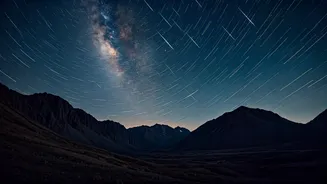








Cosmic Dust Trails
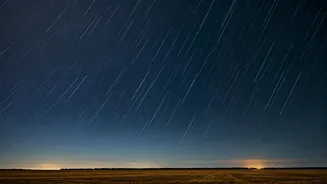
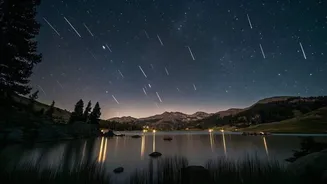
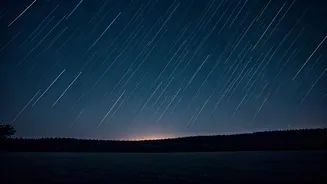
The Lyrid meteor shower is an annual celestial event that captivates observers as Earth ventures through the dusty remnants left behind by Comet Thatcher.
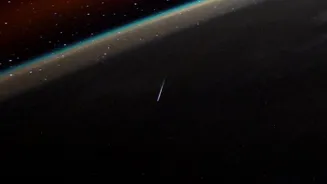
This long-period comet, with an orbital period of approximately 415.5 years, leaves a trail of debris in its wake. As our planet intersects this cosmic path, these tiny fragments encounter Earth's atmosphere at high speeds. The intense friction causes them to heat up and vaporize, resulting in the brilliant streaks of light we perceive as meteors, often referred to as 'shooting stars.' The Lyrids are renowned not only for their consistent rate of visible meteors but also for the occasional spectacular 'fireball' – an exceptionally bright meteor that can leave a lingering trail. A striking image captured from the International Space Station by astronaut Jessica Meir offers a unique perspective on these phenomena, highlighting their visual impact even from orbit.
Peak Viewing In India
In 2026, the Lyrid meteor shower will be visible in India from roughly April 16th to April 25th, with its peak activity anticipated around the night of April 21st into the early morning of April 22nd. An additional viewing opportunity with good visibility is also expected on April 23rd. During the peak, skywatchers can anticipate observing between 10 to 20 meteors per hour under ideal circumstances. For those in India, the prime viewing window typically falls between midnight and sunrise, specifically from approximately 12 midnight to 5 am IST. The period between 3 am and 5 am is often considered optimal for maximum visibility. Regions in northern and central India, including major cities like Delhi, Mumbai, and Bengaluru, are considered favourable locations for observing this astronomical event.
Maximizing Your Viewing
India is advantageously positioned in the Northern Hemisphere, offering an excellent vantage point for viewing the Lyrid meteor shower. To enhance your chances of a memorable experience, experts strongly advise seeking out a location far from the glare of urban lights. Opt for a dark, open space, such as a rural field or an unobstructed rooftop, where light pollution is minimal. A crucial tip from NASA is to allow your eyes at least 20 to 30 minutes to adjust to the darkness before you start actively observing. Lie down on your back and direct your gaze generally towards the eastern horizon. While the meteors appear to originate from a point near the constellation Lyra and its star Vega, known as the 'radiant,' it's recommended not to stare directly at Vega. Instead, let your vision rest slightly away from Lyra, which allows for a more comprehensive view of the graceful, elongated streaks as they traverse the night sky.