






The Planet Debate Reignites
Jared Isaacman, the current head of Nasa, has publicly expressed a strong inclination towards restoring Pluto's designation as a full-fledged planet. This
stance effectively reopens one of the most contentious discussions in the field of astronomy. During a US Senate hearing on April 28th, Isaacman candidly stated, “I am very much in the camp of ‘make Pluto a planet again.’” He further elaborated that initiatives are actively underway to produce scientific papers aimed at stimulating a renewed discussion among astronomers globally. These efforts are intended to formally challenge Pluto's current classification, suggesting a more structured approach to revisiting the established astronomical definitions and criteria.
Why Pluto Lost Its Title
Pluto's classification was altered in 2006 by the International Astronomical Union (IAU), which then established a new, definitive set of criteria for what constitutes a planet. For a celestial body to be considered a planet, it must satisfy three conditions: it needs to orbit the Sun, possess a nearly spherical shape, and crucially, have cleared its orbital path of other debris. Pluto successfully meets the first two requirements, appearing spherical and orbiting our star. However, it falters on the third condition as it shares its orbital neighborhood with numerous other objects within the Kuiper Belt, a vast expanse of icy bodies located in the outer solar system. This inability to dominate its orbital zone led to its downgrading to the status of a 'dwarf planet,' a decision that has since been a source of considerable controversy among both scientists and the general public.
Arguments For Planet Status
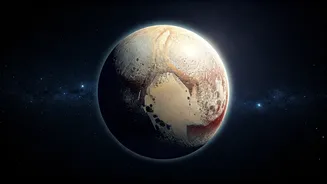
Advocates for Pluto's return to planetary status have long pointed out what they perceive as inconsistencies in the IAU's definition. They often highlight that other recognized planets, such as Earth and Jupiter, also coexist in their orbits with various asteroids and other celestial fragments, questioning why Pluto was uniquely penalized for a similar orbital characteristic. Beyond the scientific arguments, Pluto holds significant cultural importance, particularly in the United States, due to its discovery in 1930 by American astronomer Clyde Tombaugh at the Lowell Observatory. Isaacman's remarks seem to acknowledge this historical and emotional connection, suggesting that the drive to reinstate Pluto is as much about honoring past scientific achievements and cultural legacies as it is about re-evaluating its astronomical standing. The renewed interest in Pluto was significantly boosted in 2015 by Nasa's New Horizons mission, which provided unprecedented close-up images and data, revealing a complex and dynamic world with ice mountains, nitrogen glaciers, and the distinctive heart-shaped feature, Tombaugh Regio, which challenged earlier perceptions of Pluto as a simple, inert body.
The Path Forward
Despite the growing advocacy from some scientists and the current head of Nasa, the ultimate authority to redefine planetary classifications rests solely with the IAU. Only this international body possesses the power to alter the official definitions and potentially grant Pluto its former planetary status. For the moment, Isaacman's statements serve as a clear indication of a renewed push to engage the scientific community in a formal re-examination of the criteria. Whether this revitalized discussion will culminate in Pluto regaining its place among the planets remains an open question, but it is evident that the debate is far from settled and will likely continue to captivate astronomers and space enthusiasts alike.