






Booster's Second Flight
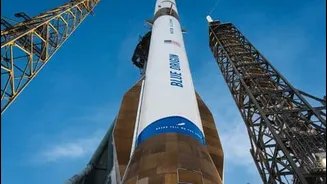
A landmark moment in rocketry occurred with the successful second flight and recovery of a New Glenn first-stage booster, an impressive feat accomplished
on the rocket's third overall launch. This marks a crucial step in the company's efforts to develop reusable launch systems. After detaching from the main rocket body approximately three minutes into the ascent, the booster executed its planned braking maneuvers, culminating in a controlled landing on a designated recovery vessel. This successful recovery, visualized in a public post by the company's owner, signifies a major advancement in the reliability and reusability of their launch technology. Achieving this milestone on only the third mission is particularly noteworthy, demonstrating rapid progress in refining the reuse process for orbital-class rockets.
Payload Mission Failure
Despite the triumph of the booster's reuse, the mission's primary payload delivery objective unfortunately did not succeed. Several hours post-launch, both the rocket company and the satellite manufacturer confirmed that the communications satellite failed to reach its designated orbit. Initial reports indicated successful payload separation and that the satellite had powered on, but subsequent analysis revealed it had been placed into an 'off-nominal orbit.' Further investigation by the satellite manufacturer clarified that the satellite's altitude was insufficient for its onboard thrusters to maintain orbit, leading to its de-orbit. This unexpected outcome means the valuable satellite, designed to test a direct-to-cell network, could not fulfill its intended function.
Orbital Insertion Snag
The satellite's journey was intended to conclude with the upper stage positioning it into a stable orbit at an altitude of 285 miles. From this vantage point, it was expected to deploy a massive 2,400 square-foot antenna and establish connections with other satellites, a key component of a planned high-speed direct-to-cell communication network. However, early telemetry data painted a different picture, showing the satellite reaching only about 95 miles above Earth's surface. This altitude is far too low to sustain orbital operations, especially with the satellite's propulsion systems. The precise reason for this orbital insertion failure remains under investigation, leaving a critical question mark on the upper stage's performance during this mission.
Future Prospects Ahead
While the payload failure is a significant setback, the successful reuse of the New Glenn booster provides a crucial foundation for future missions. The company is reportedly eager to address the issues that led to the upper stage's inability to achieve the correct orbit. The next scheduled launch is particularly important, as it will carry a significant number of broadband satellites for a major e-commerce company, aiming to expand its internet constellation. This upcoming mission presents an immediate opportunity to demonstrate the resolution of the upper stage problem and confirm the viability of their launch system for large-scale satellite deployments, vital for competing in the growing satellite internet market.