






Listening to the Sun
Scientists are gaining unprecedented insights into the Sun's turbulent interior, potentially unlocking the ability to predict solar storms with greater
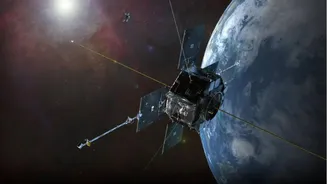
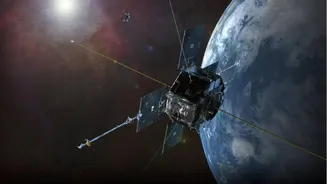
precision. A recent collaborative study, involving researchers from the Institute of Fundamental Research (TIFR) in Mumbai and New York University, Abu Dhabi, has uncovered evidence of previously undetected magnetic phenomena deep within our star. Published in the esteemed journal Nature Astronomy, this groundbreaking research utilizes a sophisticated technique known as helioseismology. Much like seismologists study Earth's internal structure by analyzing earthquake waves, helioseismologists examine the Sun by analyzing the subtle oscillations and waves that propagate through its layers. By meticulously studying over a decade's worth of observational data from NASA's Solar Dynamics Observatory, particularly information gathered by the Helioseismic and Magnetic Imager (HMI) instrument, the research team identified two distinct types of faint waves. These waves travel through the Sun's outer regions and appear to be linked to what physicists refer to as 'magneto-Rossby waves.' These are large-scale waves that emerge in rotating fluids, characterized by a complex interplay between magnetic fields and the movement of the fluid plasma.
A Doughnut of Magnetism
The newly identified waves offer a tantalizing glimpse into the Sun's internal magnetic architecture, specifically locating themselves just beneath the visible surface in the convection zone. This dynamic region is where the Sun's internal heat is transported outwards through vigorous upwelling and downwelling currents of superheated plasma. The patterns observed within these solar waves suggest the presence of a massive, toroidal—or doughnut-shaped—magnetic field residing within the Sun. While this magnetic field may be relatively weak at the solar surface, it is hypothesized to be considerably more potent in the deeper interior, where the solar plasma is far denser. Understanding this magnetic structure is critically important, as it is intricately linked to the solar cycle, the approximately 11-year period during which the Sun's activity waxes and wanes. The profound implications of these findings are still being explored, but they represent a significant step forward in our comprehension of solar dynamics and their potential impact on Earth.
Shielding Earth's Tech
The implications of these findings extend far beyond academic curiosity, directly impacting our increasingly technology-dependent world. As Professor Shravan Hanasoge, the lead researcher, explained, if these detected waves are indeed magnetohydrodynamic Rossby waves, they provide an exceptionally rare, direct view into the large-scale magnetic field concealed beneath the Sun's surface. These waves act as crucial tracers, illuminating the deep magnetic structure that fundamentally drives the solar cycle. Solar activity, ranging from the predictable ebb and flow of the solar cycle to sudden, violent events like solar flares and coronal mass ejections, can profoundly affect life and technology on Earth. Intense solar events can launch energetic charged particles into space, which can wreak havoc on satellites, disrupt global communication networks, interfere with navigation signals, and even destabilize power grids. The inherent difficulty in directly observing the intricate physics of the solar cycle has historically hampered scientists' ability to accurately forecast solar activity, leaving us vulnerable to these space weather events.
Forecasting the Storms
The recent observation of these subtle magnetic waves could revolutionize space weather forecasting by offering a novel method for real-time monitoring of internal solar processes. By tracking these waves, scientists may be able to gain a more precise estimation of the strength and characteristics of the Sun's internal magnetic field. This discovery also bridges a long-standing gap between theoretical predictions and empirical evidence regarding solar activity. For years, scientists have theorized the existence of large-scale magnetic waves within the Sun, but direct detection had remained elusive. This new evidence brings researchers closer to understanding the hidden mechanisms that govern solar magnetism. While it is still premature to definitively claim predictive power, continued analysis of solar data could lead to significantly improved forecasting of solar storms. Professor Hanasoge noted that if these waves are indeed influenced by the Sun's internal magnetic field, then monitoring their evolution over time could provide valuable insights into how that field changes during the solar cycle, potentially enhancing our ability to anticipate the intensity of future solar cycles. This enhanced predictive capability would be invaluable for space agencies, satellite operators, and energy providers, allowing them to better prepare for and mitigate the disruptive effects of solar activity.