


A Regal Abode
Nestled in the heart of Jaipur, the City Palace stands as a magnificent testament to the region's royal heritage, contrasting with the many hill-bound
forts. Established in 1727 by Maharaja Sawai Jai Singh II as part of his urban planning, this sprawling complex is a captivating fusion of Rajasthani and Mughal architectural styles. Over generations, successors added to its splendor, transforming it into an iconic symbol of Jaipur's rich cultural tapestry. Beyond being a royal residence, it served as a vibrant center for arts, learning, and spiritual practices, hosting significant festivals that bridged the palace and the city's populace. Today, its doors are open to visitors, offering a tangible connection to the captivating history and opulent lifestyle of Rajasthan's royalty.
The Origin Story
The creation of the City Palace is intrinsically linked to the foresight of Maharaja Sawai Jai Singh, the visionary ruler who founded the city of Jaipur. Between 1729 and 1732, the construction of this grand complex was undertaken concurrently with the development of Jaipur itself. This marked a pivotal moment, as it shifted the royal seat from the traditional capital of Amer and its Amber Fort. The growing population and dwindling water resources in Amer necessitated a new, more expansive royal dwelling. The Maharaja enlisted the talents of two exceptional individuals: Vidhyadhar Bhattacharya, a gifted architect, and Sir Samuel Swinton Jacob, a renowned British engineer. Their collaboration resulted in an architectural masterpiece that, alongside the city of Jaipur, continues to stand as an enduring symbol of Rajput architectural brilliance and royal legacy.
Inside the Palace
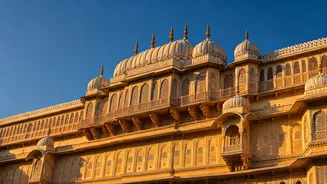
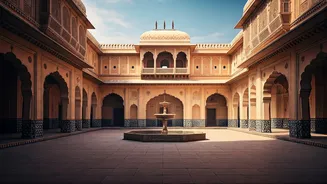
Entering the City Palace through the imposing Virendra Pol, visitors are immediately greeted by the Mubarak Mahal in the first courtyard. This striking cream-colored edifice, once a reception hall, showcases intricate carvings and elegant arches. It now houses a portion of the Maharaja Sawai Man Singh II Museum. Adjacent to it lies the enchanting Rajendra Pol, a marble gateway that guides you deeper into the palace's splendor, leading to Diwan-E-Khas. This central courtyard is a breathtaking space, adorned with crystal chandeliers and boasting impeccable marble floors and red sandstone archways, evoking a sense of a royal movie set. The palace truly comes alive during its numerous festivals. The Teej festival features a grand procession with an idol of Goddess Parvati, while Dussehra sees royal men honoring their ancestral armory. The festival of Gangaur is particularly significant for women. Other celebrations like Holi, Diwali, and Makar Sankranti offer further glimpses into Rajasthan's vibrant cultural soul.
Royal Splendor
Dominating the City Palace complex is the magnificent Chandra Mahal, or 'Moon Palace.' This seven-story architectural wonder not only preserves private royal chambers but also offers panoramic views of Jaipur's Pink City. A section of this opulent palace remains the residence of the current royal family. The first floor of the museum showcases the royal family's prized possessions, including ancient weaponry, manuscripts, exquisite carpets, blue pottery, and Indian art. Ascending further reveals more intimate glimpses into royal life. The second floor features Sukh Niwas, the 'blue room,' a sumptuously decorated royal dining hall. The third and fourth floors house the Rang Mandir ('Mirror Room') and Shobha Niwas ('Hall of Beauty'), both resplendent with intricate mirror work and embellished tiles. Higher levels include Chavi Niwas, the Maharaja's former resting place, and Shri Niwas and Mukut Niwas, offering unparalleled city vistas. Standard tickets grant access to the first floor, but a 'Royal Splendour' ticket unlocks access to these more exclusive areas.
Beyond the Palace
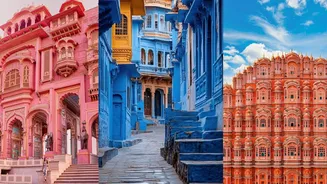
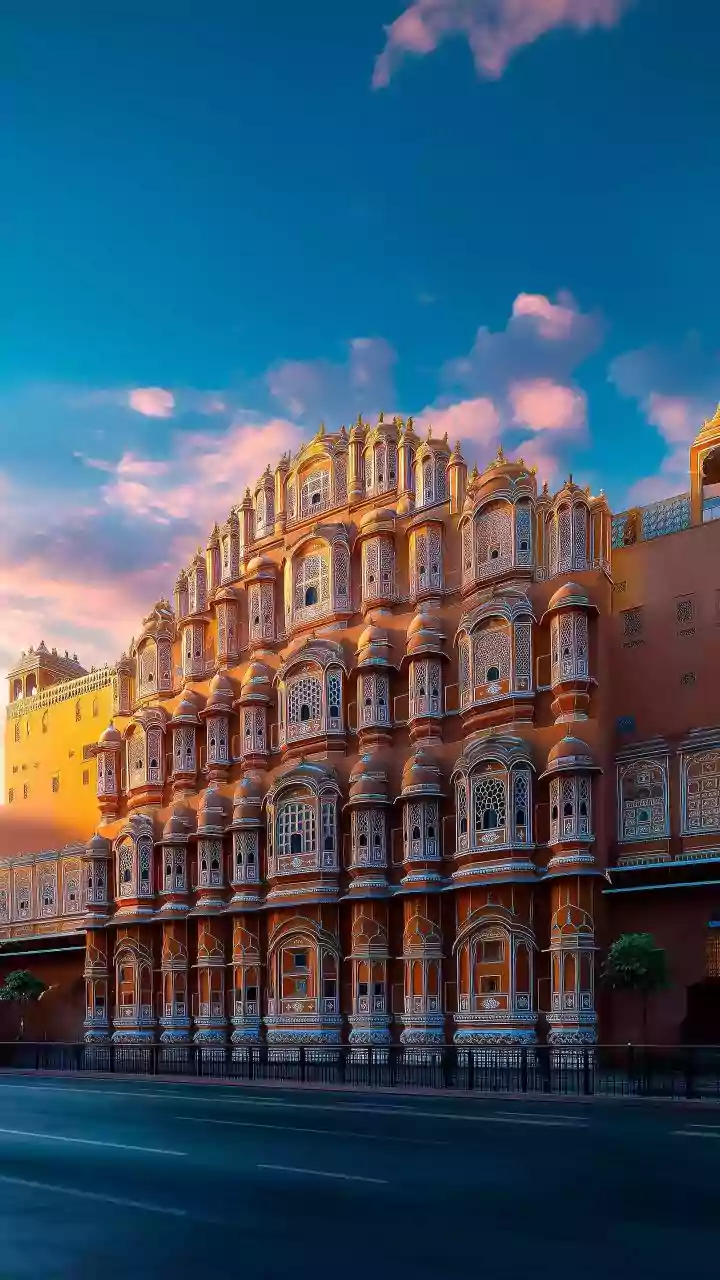
While the City Palace is a crown jewel, Jaipur offers a wealth of other attractions that complement its grandeur. The imposing Amber Fort, once the seat of Rajput power, stands majestically overlooking Maota Lake. Nearby, the Jantar Mantar observatory showcases the region's scientific heritage with its remarkable collection of astronomical instruments. No visit to Jaipur is complete without exploring the vibrant bazaars encircling the City Palace, offering a perfect opportunity to admire the Hawa Mahal while enjoying a coffee from a rooftop cafe. These sites collectively form a rich tapestry of cultural experiences that beautifully enhance the allure of the City Palace, providing visitors with a comprehensive understanding of Jaipur's historical and artistic legacy.