







Colossal Beginnings
The pursuit of creating monumental sculptures has captivated humanity for centuries, with various cultures striving to erect symbols of faith, power, or remembrance
that dwarf the ordinary. These aren't just artistic expressions; they are feats of modern engineering and human ambition. The materials used range from concrete and steel to stone and bronze, all meticulously assembled to withstand the elements and inspire awe for generations. Understanding the construction of such colossal figures reveals a fascinating interplay between artistic vision and practical engineering challenges, often involving complex scaffolding, intricate foundation work, and innovative construction techniques to achieve unprecedented heights. The sheer scale necessitates meticulous planning and execution, often employing specialized teams and advanced technology to bring these giants to life. Each statue represents a significant investment of resources and a testament to the desire to create enduring landmarks that resonate with cultural and historical importance, often drawing inspiration from religious figures, national heroes, or abstract concepts. The initial stages of conceptualization and design are critical, laying the groundwork for the immense undertaking that follows, ensuring both structural integrity and aesthetic impact.
Giants in Focus
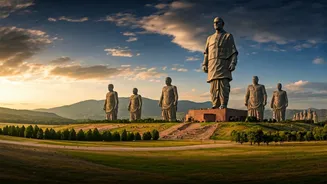
Standing at a staggering 597 feet, the Statue of Unity in Gujarat, India, proudly claims the title of the world's tallest statue. This monumental tribute to Sardar Vallabhbhai Patel, a key figure in India's independence movement, is a remarkable engineering achievement. Its immense scale allows it to be seen from miles away, serving as a powerful symbol of national pride and unity. Following closely is the Spring Temple Buddha in China, soaring to 420 feet, a breathtaking representation of Buddhism that attracts pilgrims and tourists alike. Another notable structure is the Laykyun Sekkya Buddha in Myanmar, reaching 377 feet, embodying peace and serenity. The Ussu, also known as the Motherland Calls statue in Volgograd, Russia, stands at 279 feet, a powerful commemoration of a pivotal World War II battle. These statues are not merely static objects; they are dynamic landmarks that draw millions of visitors annually, contributing significantly to local economies and fostering cultural exchange. Their construction involved overcoming significant logistical and technical hurdles, requiring immense planning and skilled labor to erect them to such imposing heights, making them truly awe-inspiring sights.
Engineering Marvels
The construction of these gigantic statues pushes the boundaries of architectural and engineering capabilities. For instance, the Statue of Unity, with its height of 597 feet, required an intricate internal structure of steel and concrete to support its immense bronze cladding. Similarly, the Spring Temple Buddha, standing 420 feet tall, features a complex framework designed to bear the weight of its bronze sections and withstand environmental factors. The process often involves advanced techniques like slip-forming for concrete cores and modular assembly of prefabricated components. Engineers must meticulously calculate wind loads, seismic activity, and the sheer gravitational forces acting upon these colossal structures. The foundation design is equally critical, ensuring a stable base capable of supporting thousands of tons. Furthermore, the transportation and lifting of massive components to great heights present unique logistical challenges. Innovations in crane technology, temporary support structures, and precise material management are essential to the successful completion of these projects, turning ambitious artistic visions into tangible, towering realities that inspire wonder and admiration across the globe.