
Beyond the Official Plate
The Uttar Pradesh government's 'One District, One Cuisine' scheme, which designated 208 dishes, notably excluded many meat-based specialties like Tunday's
Galawati, Awadhi and Moradabadi biryanis, and Kakori kebabs. This selection is puzzling for a state where meat consumption spans across various social strata. The author argues that this list fails to represent the actual culinary reality of Uttar Pradesh, presenting a curated, almost fictionalized, gastronomic map. The initiative, intended to celebrate regional food, paradoxically simplifies and flattens a complex, evolving culinary heritage, akin to trying to capture a vast, vibrant painting with a single brushstroke. The exclusion of dishes like 'Char Magaz ka Murga,' a Hindu Kayastha recipe, highlights how the list ignores the deep integration of culinary practices across different communities and traditions within the state.
A Shared Culinary Heritage
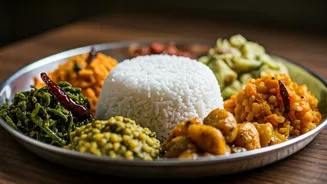
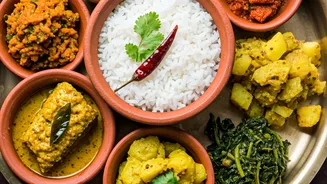
Uttar Pradesh's food traditions are far from being segregated by religion; instead, they are characterized by a continuous and extensive exchange between vegetarian and non-vegetarian preparations. Dishes and techniques have fluidly migrated across communities, demonstrating a cuisine that is essentially one, taking turns at the cooking hearth. For instance, Tehri, a rice and vegetable dish assigned to Azamgarh, shares common ground with biryani, using the same grain, cooked in similar pots, and prepared by the same hands. The iconic Galawati kebab, originally conceived for the aristocracy, is now a beloved street food enjoyed by all in Lucknow, even spawning vegetarian versions. In Banaras, the sweet makers and kebab vendors have coexisted and influenced each other for centuries. Similarly, the Rohilla technique of 'Taar Gosht' from Rampur has been embraced and adapted by Hindu households for their own festive occasions. This intricate interweaving of flavors and methods underscores that UP's food is not a set of parallel, distinct cuisines, but a unified culinary narrative.
Diplomatic Tables, Abundant Feasts
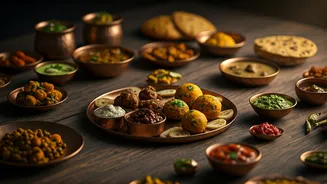
The author draws a parallel between the curated list and India's historical state banquets, which have consistently showcased culinary diversity and abundance. Menus presented to dignitaries like Nelson Mandela and General Pervez Musharraf featured a wide array of regional dishes, blending vegetarian and non-vegetarian items, and symbolizing inclusivity. Even in recent times, state dinners have aimed for a balance, such as hosting a Vietnamese president, whose national dish is pho bo, with an entirely vegetarian banquet. These high-profile occasions demonstrate a tradition of presenting a table that offers choice and variety, where guests are not compelled to select one culinary path over another. This contrasts sharply with the restrictive nature of the 'One District, One Cuisine' list, suggesting a shift in how culinary representation is perceived at the highest levels, moving towards a more cautious, perhaps even narrower, approach.
The Essence of Culinary Creativity
The curation of a single dish per district, while perhaps well-intentioned, risks stifling the very creativity that defines a cuisine. A cuisine is not merely a collection of recipes but a dynamic relationship between dishes, a tapestry woven over generations by cooks who have continuously evolved traditions, often forgetting the original source of a recipe. When a government demarcates an official culinary identity, it inadvertently diminishes the innovative spirit that arises from the free exchange and adaptation of dishes across communities. A sweet maker who traditionally prepared different sweets for Eid and Diwali, catering to the diverse celebrations of their clientele, may now feel pressured to focus on only one tradition. This process leads to a homogenization, where the rich, multifaceted fabric of a cuisine is simplified into a uniform pattern, constricting the kitchen's potential for growth and adaptation.
Food's Messy, True Story
Food is inherently complex and deeply connected to human experiences, carrying the echoes of migrations, family gatherings, and moments of comfort. To distill this vibrant reality into a government-issued list, especially one that omits significant portions of a region's culinary heritage, is to lose the very essence of what makes food meaningful. The author acknowledges that the omissions in the 'One District, One Cuisine' list might not have been intentional, and that there is an openness to adding more dishes. However, a true culinary identity cannot be constructed through a bureaucratic process of petitions and official approvals. The fundamental question remains: was the exercise of selecting a single dish per district the right approach to capture the multifaceted culinary landscape of Uttar Pradesh? Until this is addressed, people will continue to cook and cherish the foods they have always known, from the Galawati at Tunday's to the Nihari at Raheem's, and the diverse dishes shared in family kitchens. A cuisine is ultimately defined not by governmental recognition, but by the collective memory and practice of its people.