




The Phenomenal Asperitas
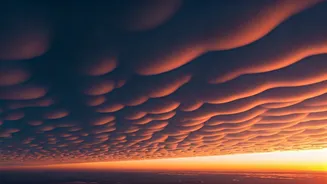
Prepare to be astonished by Asperitas clouds, a recently recognized marvel that transforms the sky into a dramatic spectacle. These formations present
a turbulent, undulating underside, evoking the appearance of rough seas viewed from below. Officially documented in 2017, Asperitas clouds are a testament to the dynamic and often surprising nature of our atmosphere, arising from unique atmospheric instabilities that create these stunning, wave-like patterns. Their visual impact is profound, turning an ordinary sky into a breathtaking canvas. They stand as a prime example of how meteorological phenomena can captivate and inspire awe, reminding us of the vast, untamed beauty above us and the ongoing discoveries within atmospheric science that continually reshape our understanding of the skies.
Ethereal Fallstreak Holes
Discover the enigmatic charm of Fallstreak Holes, also known as 'hole punch' clouds, which create peculiar circular gaps in uniform cloud layers. These intriguing celestial voids materialize when a supercooled water droplet within a cloud freezes and rapidly descends as ice crystals. This sudden crystallization triggers a chain reaction, causing nearby water droplets to evaporate, thus forming the distinct, almost artificial-looking holes. Their appearance is often fleeting, adding to their mystique. These formations offer a glimpse into the delicate balance of temperature and moisture in the upper atmosphere, where a slight change can lead to such striking visual anomalies, making them a captivating subject for skywatchers and meteorologists alike.
Dancing Kelvin-Helmholtz
Witness the fleeting beauty of Kelvin-Helmholtz clouds, a rare and mesmerizing phenomenon that mimics the appearance of breaking ocean waves. These clouds form at the boundary between two air layers moving at significantly different speeds. The shear stress generated by this wind differential creates an unstable wave pattern that curls over on itself, much like a wave cresting and breaking. Their transient nature means they often appear and dissipate quickly, making their sighting a special event. The dynamic interplay of air currents is responsible for this breathtaking display, showcasing the fluid dynamics of the atmosphere in a visually spectacular and ephemeral form that evokes the power and grace of the sea.
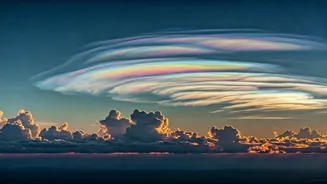
Mysterious Lenticular Forms
Encounter the otherworldly allure of Lenticular clouds, formations that bear an uncanny resemblance to smooth, stacked lenses or even flying saucers. These distinct clouds typically manifest over mountainous regions when stable, moist air flows smoothly across elevated terrain. As the air ascends over the peaks, it cools, condenses, and forms clouds. Upon descending the leeward side, the air warms and the cloud dissipates, leading to these lens-shaped formations that appear stationary, even in strong winds. Their unique appearance has led to frequent misidentification as UFOs, adding another layer of intrigue to these remarkable atmospheric sculptures that are a product of precise aerodynamic and meteorological conditions.
Pouch-like Mammatus
Observe the peculiar and striking appearance of Mammatus clouds, characterized by their distinctive pouch-like structures that hang beneath the base of larger cloud formations. These intriguing clouds are most frequently observed in the aftermath of intense thunderstorms, developing when sinking air within the storm cloud mixes with the surrounding air. The downward movement of cold, moist air creates these bulbous protuberances, which can appear in rows or clusters. Their visual impact is both dramatic and unusual, signaling significant atmospheric turbulence and providing a captivating, albeit often ominous, celestial display that is instantly recognizable and scientifically fascinating.
Nocturnal Glowing Wisps
Gaze upon the ethereal glow of Noctilucent clouds, the highest clouds in Earth's atmosphere, which shimmer in the twilight sky long after sunset. Composed of minuscule ice crystals, these clouds are illuminated by sunlight that has already passed below the horizon, creating a luminous, silvery-blue spectacle visible during the summer months at high latitudes. Their extreme altitude, reaching over 76 kilometers (47 miles), makes them a unique subject of study, offering insights into the upper mesosphere. The delicate, wave-like patterns often observed in Noctilucent clouds add to their otherworldly beauty, transforming the night sky into a canvas of soft, radiant light.