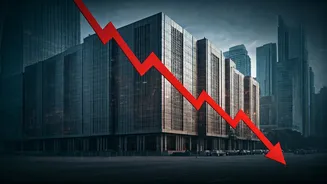

Market's Sudden Drop
The Indian stock market has recently experienced a significant downturn, leaving investors reeling from substantial losses. Specifically, the Sensex fell
by 1,500 points in just two days. This drastic fall has led to a massive erosion of investor wealth, with a staggering ₹13 lakh crore wiped out during this period. Several factors have converged to create this challenging environment, causing significant concern among market participants and raising questions about the stability of current investment strategies. This downward trend underscores the inherent volatility of the stock market and its sensitivity to both domestic and international economic forces.
IT Sector's Role
One of the key contributors to the market's poor performance has been the downturn in the IT sector. Companies like Wipro and LTIMindtree experienced a sudden evaporation of CEO rallies, as investors showed their disapproval. The IT sector, which has been a significant driver of growth, has faced challenges that impacted investor confidence. These challenges include, among other things, shifts in global economic conditions and changes in demand. The IT slump contributed considerably to the overall market sentiment, which increased the downward pressure. This is a clear indicator of how closely various sectors are interrelated and how a downturn in one can have a ripple effect across the entire market.
Investor Sentiment Impact
Investor sentiment played a crucial role in amplifying the market's downward momentum. As stock prices declined, many investors became increasingly cautious, leading to a cascade of selling pressure. This reaction is typical during market corrections, as fear often drives investment decisions. In times of uncertainty, investors tend to pull back, reinforcing the downward trend. This can be caused by fears about the general economy, specific sector performance, or broader geopolitical issues. This chain reaction often leads to a rapid decline, as seen during the recent market crash. Analyzing these dynamics is essential for both understanding the short-term market behavior and developing more resilient investment strategies.
Additional Contributing Factors
While the IT sector's struggles and overall investor sentiment have been key contributors, other factors also weighed on the Indian stock market. Global economic uncertainties and shifts in geopolitical landscapes have created volatility. Changes in interest rates by international central banks can directly influence investment flows. There is also potential impact from changes in commodity prices and fluctuations in currency values. Several external factors create an unstable environment that investors must navigate. Understanding these external factors, as well as the IT sector and investor sentiment, provides a comprehensive view of the market dynamics. These elements combine to shape the overall direction and magnitude of market movements.