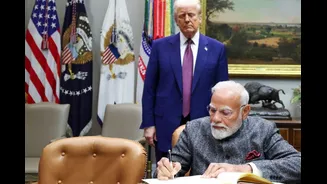
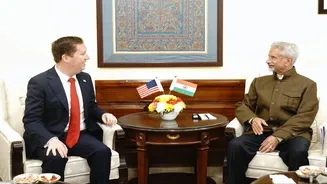
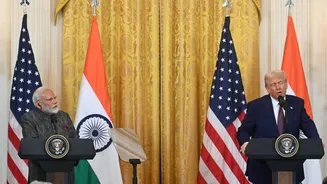
In a significant development, the United States and India have reached a trade deal. This agreement has spurred a wave of optimism, especially within the financial markets. The main highlights involve reduced tariffs and a shift in trade dynamics. Here's a look at the key details of the trade deal and its implications for both nations.
Market's Jubilation
The announcement of the trade deal between India and the United States triggered a substantial rally in the Indian stock market. On Tuesday, February 3, 2026, the Sensex surged by a remarkable 3,656.74 points at the start of the trading session, reaching 85,323.20. The Nifty also experienced a considerable boost, gaining 1,129.65 points to open at 25,088.40. These gains, however, were not isolated to the opening hours, as the benchmarks rose by about 5% during the day, marking their biggest intra-day jump in five years. This positive reaction indicates a strong investor confidence in the deal's potential to stabilize the market and stimulate economic growth. The rapid increase in indices showcases how the market welcomed the agreement.
Trade Deal Details
The core of the India-US trade deal involves adjustments to the existing tariff structures. Under the agreement, the US decided to reduce its tariffs on Indian goods. Specifically, these tariffs were cut to 18% from the previous 50%. In return, India is expected to lower its trade barriers and curb purchases of Russian oil. The deal was viewed as critical by policymakers due to concerns about capital outflows from India and the resultant pressure on the rupee. Experts predicted that the agreement would help to stabilize the currency, leading to a stronger rupee and a market rally. The impact of the deal also extends to broader geopolitical considerations, with the agreement reflecting the strengthening of the US-India alliance to counteract China’s influence.
Impact on Sectors
The trade deal had a pronounced impact on specific sectors within the Indian economy. Reliance and export-oriented stocks experienced significant gains, driving the market's upward trajectory. The benchmark Nifty came close to its record-high levels due to the removal of a market overhang. Furthermore, US leaders and officials expressed optimism about the agreement. US Secretary of Agriculture Brooke Rollins highlighted that the deal would boost American farm exports to India's substantial market, which is expected to lift prices and infuse cash into rural America. The US agricultural trade deficit with India, which was $1.3 billion in 2024, is likely to be impacted as well. This indicates a multi-faceted impact, benefiting farmers, exporters, and the overall economic landscape.
Political Reactions
The India-US trade deal has garnered praise from key political figures in both nations. US leaders hailed the agreement, emphasizing its role in exporting American farm products to India and in countering Russian aggression. Senator Jim Risch, Chairman of the Senate Foreign Relations Committee, congratulated President Trump, calling India a ‘close partner’ and highlighting the significance of reducing trade barriers. In India, various ministers and officials echoed similar sentiments. Ashwini Vaishnaw, a Union Minister, described the deal as ‘win-win.’ Home Minister Amit Shah hailed it as a ‘big day for India-US relations.’ These reactions reflect the strategic importance of the deal and the strengthening of ties between the two nations.