






Emperor Penguins
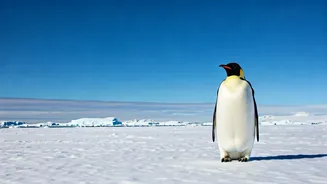
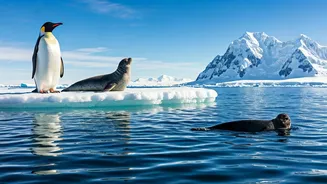
Emperor penguins are truly iconic inhabitants of Antarctica, known for their remarkable resilience. These birds endure the continent's most brutal conditions,
including temperatures as low as -40°C and powerful blizzards. Their survival is a testament to their incredible adaptations. One significant adaptation is their dense, waterproof feathers, which trap air to provide insulation. Emperor penguins also huddle together in large groups to conserve heat, sharing body warmth to survive the harsh winters. These penguins breed during the Antarctic winter, with males incubating the eggs while the females forage for food. Their life cycle is deeply intertwined with the sea ice, which serves as a crucial platform for breeding and raising their young. They are a true symbol of Antarctic endurance and resilience.
Adélie Penguins
Adélie penguins are another well-known species of Antarctica, easily recognized by their distinctive black and white plumage. Unlike emperor penguins, Adélie penguins breed in the warmer coastal regions during the Antarctic summer. These agile birds are highly social, forming large colonies where they build nests of stones. Their diet primarily consists of krill, small crustaceans that are abundant in Antarctic waters. Adélie penguins are remarkable divers, capable of reaching depths of up to 175 meters in search of food. They are also known for their playful behavior and their ability to navigate treacherous ice conditions. The Adélie penguin population serves as a critical indicator of the health of the Antarctic ecosystem, making them a significant species for scientific research.
Chinstrap Penguins
Chinstrap penguins, characterized by the black band under their chin, are another penguin species found on the Antarctic Peninsula and surrounding islands. These penguins are named for the thin black stripe that resembles a chinstrap. They are highly adaptable and are known for their ability to thrive in a variety of environments, from rocky shores to ice-covered areas. Chinstrap penguins are skilled swimmers and divers, feeding on krill, fish, and small crustaceans. Their breeding colonies can be exceptionally large, with thousands of pairs nesting together in close proximity. These penguins build their nests with stones, carefully selecting materials to raise their chicks. Their population dynamics are closely monitored to understand the effects of climate change and other environmental factors on the Antarctic ecosystem.
Crabeater Seals
Despite their name, crabeater seals primarily consume krill, rather than crabs. These seals are one of the most abundant seal species in Antarctica. They are characterized by their sleek bodies, which are perfectly adapted for swimming and navigating the icy waters. Their teeth have intricate cusps that allow them to effectively filter krill from the water. Crabeater seals are often found on ice floes, where they haul out to rest, breed, and give birth. They are known to be solitary creatures, although they can sometimes be seen in small groups. These seals play a crucial role in the Antarctic food web, serving as both predators and prey. Their population is influenced by factors such as krill abundance and the presence of leopard seals, which prey on them.
Weddell Seals
Weddell seals are large, robust seals that are well-adapted to the frigid Antarctic environment. They are known for their thick blubber layer, which provides insulation against the cold and helps them to conserve energy. Weddell seals are highly skilled divers, capable of staying underwater for extended periods. They often dive to depths of several hundred meters in search of fish and other prey. They maintain breathing holes in the ice, allowing them to access the surface even when the sea is frozen. These seals are known for their gentle and curious nature, often approaching humans without fear. Weddell seals are an important part of the Antarctic ecosystem, with their population reflecting the health of the marine environment and serving as an indicator for climate change impacts.
Leopard Seals
Leopard seals are formidable predators in the Antarctic marine ecosystem. These seals are named for their spotted coats and are known for their agility and hunting prowess. They are opportunistic feeders, preying on penguins, seals, and fish. Leopard seals have powerful jaws and sharp teeth, which they use to capture and consume their prey. They are often seen patrolling the waters near penguin colonies, waiting for opportunities to hunt. While they are a predator to other seals, they also contribute to the balance of the ecosystem, controlling the populations of prey species. Their presence in the Antarctic environment is a sign of a healthy and diverse food web.
Antarctic Krill
Antarctic krill is not an animal that most travelers see directly, but it is a foundational species of the Antarctic ecosystem. These small, shrimp-like crustaceans are a primary food source for many of the larger animals in the region, including whales, seals, penguins, and fish. Krill consume algae and phytoplankton, and they, in turn, provide energy for the entire Antarctic food web. They form massive swarms, making them accessible to a wide range of predators. Krill populations are heavily influenced by environmental factors such as sea ice extent and ocean temperature, making them a crucial indicator for climate change effects on the Antarctic ecosystem. The sustainability of the krill population is vital to the health of the entire Antarctic environment and the survival of the other animals.