







Enhanced Fiber Design
Telecommunications are undergoing a seismic shift as the demand for data skyrockets, fueled by rapid advancements in 5G networks, artificial intelligence,
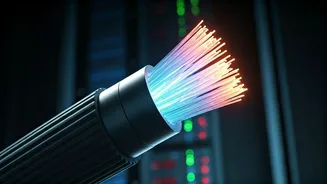
and cloud computing. Traditional methods of increasing capacity often involve laying more physical infrastructure, a process that is both time-consuming and financially burdensome. To circumvent these challenges, a leading Japanese telecommunications company has engineered an advanced multicore optical fiber (MCF). This innovative fiber features four distinct cores housed within a single strand, unlike conventional fibers which typically contain only one. This multi-core architecture enables the transmission of multiple independent optical signals simultaneously, effectively multiplying the data-carrying potential. The critical aspect of this development is its adherence to existing cable dimensions, ensuring seamless integration with current undersea and terrestrial networks, thereby avoiding costly and complex overhauls. This ingenious design allows for a significant leap in data throughput without any increase in the physical footprint of the cabling.
Strategic Infrastructure Integration
The practical implementation of this new four-core optical fiber hinges on its seamless integration with the existing global telecommunications infrastructure. Recognizing this, the developers have engineered a suite of specialized accessories designed to bridge the gap between the advanced MCF and conventional systems. Key among these is the submarine joint box, a vital component that facilitates the connection of standard terrestrial fiber optic cables to the multi-core undersea cables. Furthermore, a specialized MCF cable terminal has been developed. This terminal is essential for linking the new fiber to transmission equipment that is currently designed to operate with single-core optical cables. For the intricate process of laying and repairing undersea cables, a factory joint box has also been created, enabling cable layers to securely connect two MCF cables together on the seabed. These carefully designed accessories are paramount to ensuring that the revolutionary capacity increase offered by the MCF can be realized without necessitating a complete replacement of the world's vast network of optical infrastructure.
Future Rollout and Benefits
The deployment of this revolutionary optical fiber technology is slated for 2029, marking a significant milestone for the telecommunications industry. Companies will soon have the opportunity to integrate this enhanced capacity solution into their upcoming projects, a move that promises to streamline network upgrades and enhance competitiveness. The ability to quadruple data throughput within existing cable sizes offers a dual advantage: it effectively addresses the soaring demand for data transfer without the immense cost and logistical hurdles associated with laying new physical cables. This means that future network expansions and upgrades can be accomplished more economically and in less time. Moreover, the MCF technology could potentially reduce the overall deployment timelines for new projects, making them more attractive and viable compared to existing, less efficient networks. The implications are far-reaching, suggesting a future where global data connectivity is both more robust and more accessible.