





Flutter: A Dangerous Phenomenon
Flutter is an aerodynamic instability that can rapidly destabilize an aircraft's control surfaces, leading to catastrophic failure. It occurs when aerodynamic forces,
inertia, and elastic forces on a control surface interact, creating self-sustaining oscillations. Imagine a flag whipping violently in the wind; this is a simplified representation of flutter. In aircraft, this oscillation can escalate within seconds, becoming incredibly dangerous during flight. Flight testing for flutter involves incrementally increasing airspeed to pinpoint the speed at which these vibrations begin, a process requiring extreme caution. The onset can range from a subtle vibration to violent shaking, a stark reminder of the inherent forces at play during flight and the importance of understanding these aerodynamic phenomena.
The Role of Counterweights
Counterweights are strategically placed on aircraft control surfaces, such as ailerons and flaperons, to prevent flutter. Their primary function is to shift the surface's center of gravity forward, moving it closer to the hinge line. This repositioning ensures that the forces acting on the control surface are resolved near the pivot point, significantly reducing its susceptibility to flutter. While the goal of aircraft design is often to minimize weight, eliminating these counterweights for perceived savings is a critical error. They are not dead weight; they are engineered safety features that ensure the control surface remains stable at all operational speeds, including Vne (Velocity Never Exceed). The balancing doesn't need to be perfect, but sufficient to suppress flutter below Vne.
Balancing for Stability
Achieving the right balance for control surfaces is a nuanced engineering task. A perfectly balanced surface would remain neutral when disconnected, neither dipping nose-up nor nose-down. An under-balanced surface would settle tail-down, while an over-balanced one would do the opposite. The critical factor is not absolute balance, but rather achieving a state where flutter is prevented below the aircraft's maximum safe speed (Vne). This often involves a trade-off between the amount of weight used and the length of the control arm. Some designs opt for shorter control arms with denser materials to keep counterweights internally, minimizing aerodynamic drag. The objective is to add only the necessary weight to ensure stability within the expected flight envelope.
Design Choices and Materials
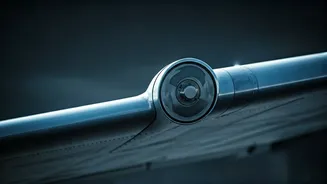
The placement and composition of counterweights are influenced by design considerations and the need to minimize drag. In some aircraft, like the P-38 or the de Havilland DH.88 Comet, counterweights are externally visible, protruding from the tail plane or ahead of the rudder, respectively. This external placement allows for a shorter control arm but increases aerodynamic drag. For homebuilt aircraft, a blend of internal and external counterweights is common. Internal counterweights, often made of dense materials like lead, are preferred to keep them out of the airflow. On larger commercial airliners, depleted uranium (DU) is sometimes used due to its extreme density, allowing for very compact counterweights that can be fully enclosed. Fabric-covered control surfaces on WWII aircraft also served to reduce overall weight, thereby lessening the counterbalancing needed.
The Perils of Modification
Modifying aircraft designs, especially concerning weight and structural integrity, requires extreme caution and expert knowledge. Builders may be tempted to increase the thickness of materials, such as wing skins, believing it enhances strength. However, such changes can add significant unneeded weight, potentially affecting the center of gravity and overall aircraft performance. Designers meticulously calculate material strengths and loads; casual deviations from blueprints can compromise safety. Any alteration, particularly to critical components like control surfaces, should be approached with a thorough understanding of its implications and ideally with approval from the original designer or a qualified engineer. Ignoring the purpose of specific components, like the Kitfox counterweights, can have severe repercussions.