
Faster Space Solutions
The U.S. Space Force is driving a significant transformation in satellite development, focusing on shortening the time required to build and deploy these
crucial assets. This shift is a direct response to the increasing speed of modern counterspace threats, emphasizing the need for quicker reactions. The Tactically Responsive Space (TacRS) initiative is central to this effort, aiming for greater agility in space domain awareness and rapid-response launch capabilities. A core element of this strategy involves building or storing satellites in advance and adding sensors only when mission requirements emerge. The goal is to dramatically reduce the development cycle, potentially saving months compared to traditional methods. This initiative is a proactive measure designed to maintain a competitive edge in space, ensuring that the Space Force can quickly address and respond to emerging orbital threats with advanced capabilities.
Handle 2.0 Emerges
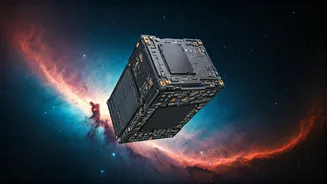
A pivotal aspect of this modernization is the development of Handle 2.0, an upgraded version of a modular, open-system electronics interface. Falcon ExoDynamics, a small defense contractor based in California, secured a $3.3 million contract in late 2025 to lead the development of Handle 2.0, in partnership with The Aerospace Corporation. This interface is designed to provide a standardized power-and-data connection point between satellite buses and payloads, allowing for flexible integration. Handle was initially created to minimize custom redesigns when integrating payloads on smaller satellites. The enhanced Handle 2.0 is designed to support a wider array of payloads, promoting standardization in satellite designs across the Space Force. The original Handle interface was successfully tested in orbit during Aerospace's Slingshot 1 mission, launched in July 2022. This evolution underscores a strategic move towards adaptable, responsive space capabilities, which is crucial for modern defense strategies.
Victus Salo Mission
A key demonstration of the new technology is the Victus Salo mission, scheduled for launch in late 2026. This mission will test the rapid deployment and on-orbit maneuvering capabilities of new systems, which are essential for counteracting potential threats to U.S. spacecraft. It will launch into low Earth orbit via SpaceX's rideshare program, carrying a payload provided by MIT Lincoln Laboratory. The primary objective is to prove the feasibility of quick launch and responsive operations in space. The Victus Salo mission, alongside other initiatives within the TacRS program, seeks to enhance space domain awareness and ensure a swift reaction to any developing threats in orbit. Impulse Space is constructing an orbital maneuver vehicle to carry the Lincoln Laboratory payload, which will allow the spacecraft to reposition itself once in orbit as part of the mission demonstration. The mission also aims to validate the basic design of Handle, including data links and command systems.
Standardizing Satellite Design
The Space Force's strategy to standardize satellite designs represents a significant shift towards greater efficiency and adaptability in space operations. This move is supported by Col. Bryon McClain, who emphasized that the traditional development timelines are not adequate to meet current operational needs. The new approach is designed to shorten satellite development and deployment times significantly, enabling quicker responses to evolving orbital threats. The implementation of Handle 2.0 is crucial, enabling faster integration of complex subsystems and supporting smart systems engineering practices. The modular nature of Handle 2.0 allows for late-stage payload integration, which enhances flexibility and reduces costs. This innovative approach promises to revolutionize how the Space Force builds, launches, and manages its satellite assets, ensuring that they can remain ahead of any potential threats.