






Satellite's Final Journey
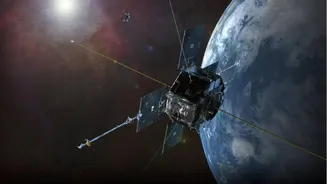
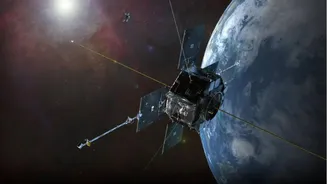
NASA's Van Allen Probe A, a substantial satellite weighing approximately 1,323 pounds (600 kilograms), is on a trajectory to re-enter Earth's atmosphere
around March 10th. This marks the end of an extended mission that began with its launch alongside its twin, Van Allen Probe B, in August 2012. The primary objective of these probes was to meticulously study the Van Allen radiation belts, regions of energetic charged particles encircling our planet. Both probes, though deactivated in 2019, continued their orbital paths until now. Projections indicate that the vast majority of the satellite's structure will disintegrate due to the intense heat and friction encountered during its atmospheric passage. However, there's a possibility that certain robust components might withstand this fiery ordeal and survive the descent. These surviving fragments are expected to land in oceanic areas, significantly reducing any potential threat to human populations.
Understanding Reentry Risks
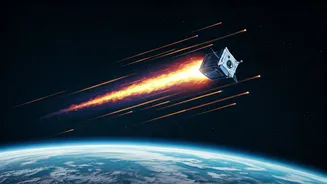
While the prospect of a satellite returning to Earth might sound alarming, scientific assessments have largely allayed concerns regarding public safety. Experts have calculated that the probability of any individual experiencing harm from the descending debris is exceptionally low, estimated at around 0.02 percent. This equates to a chance of roughly 1 in 4,200. The U.S. Space Force will be diligently monitoring the reentry process and providing real-time updates. This continuous tracking is crucial for refining the predictions for the exact timing of the satellite's return, offering greater precision as the event draws nearer. The estimated reentry window is around 7:45 p.m. EDT on March 10th, with a possible variation of up to 24 hours, highlighting the dynamic nature of orbital mechanics.
The Van Allen Probes Mission
Originally known as the Radiation Belt Storm Probes, the Van Allen mission was designed for a relatively short lifespan of two years. However, both probes far exceeded these initial expectations, with Probe A continuing its valuable data collection until October 2019 and Probe B operating until July 2019. Their orbits were highly elliptical, taking them from as close as 384 miles (618 km) to as far out as 18,900 miles (30,415 km) from Earth. Over their extended operational periods, these probes gathered critical information about the dynamics of the radiation belts. Scientists utilize this data to enhance their understanding of how solar activity impacts satellites, the health of astronauts, and even essential terrestrial systems like GPS, communication networks, and power grids. The insights gained have led to improved space weather forecasting and a better preparedness for potential disruptions caused by solar storms.
Orbital Decay and Future Missions
Recent solar activity has played a role in the accelerated descent of Probe A. Increased solar output has caused Earth's atmosphere to expand, leading to greater atmospheric drag on satellites in orbit. This increased resistance is likely the reason Probe A's orbit decayed sooner than initially anticipated. In contrast, its twin, Probe B, is not expected to re-enter Earth's atmosphere until approximately 2030, its descent seemingly less influenced by these recent solar events. Even though both probes have been deactivated, their continued presence in orbit serves as a valuable reference point for ongoing research into space weather phenomena. Furthermore, tracking their gradual orbital decay and understanding the effects of atmospheric drag provide essential lessons for managing the longevity and safety of other active satellites crucial for various scientific and operational purposes.