







Celestial Spectacle of May
The arrival of May's new moon signifies a period of profound darkness in the night sky, offering an unparalleled canvas for observing the cosmos. Occurring
on May 16th at 4:01 p.m. EDT (2001 GMT), this phase positions the moon close to the sun, ensuring moonless nights ideal for astronomical pursuits. These dark skies are a stargazer's dream, allowing us to navigate the vast expanse of stars, nebulas, and distant galaxies that become visible once the sun dips below the horizon. It’s the perfect time to cast your gaze upwards and immerse yourself in the sheer magnificence of the universe, far from the obscuring light of our natural satellite. Many ancient cultures have long observed the moon's phases and their impact on celestial viewing, and this May presents a particularly auspicious time to connect with the night sky's grandeur.
Leo and Little Lion
As twilight deepens in May, the spring sky reveals majestic constellations, including the Great Lion, Leo. Its prominent sickle-shaped pattern of stars, visible above the southwestern horizon after sunset, represents the lion's mane and chest, with the star Regulus marking its lowest point. This celestial depiction dates back nearly two millennia to the Greek philosopher Ptolemy, who identified it with the Nemean Lion from the myths of Heracles's labors. A short distance above Leo's sickle, approximately ten degrees, lie the fainter stars of Leo Minor, the 'little lion,' an asterism established by Polish astronomer Johannes Hevelius in 1690. Lacking grand mythological origins, Leo Minor serves as a charming celestial bridge between the more prominent constellations of Leo and Ursa Major, the Great Bear. Together, these leonine figures offer a fascinating glimpse into astronomical history and mythology.
The Serpent Lynx
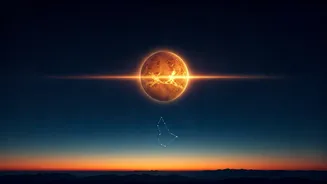
Adjacent to Leo Minor, towards the lower right, is the constellation Lynx, marked by the star Alpha Lyncis, a magnitude +3.25 object. This constellation forms the leftmost point of a serpentine pattern of eight stars that stretches across the northwestern horizon for observers in the Northern Hemisphere. The exceptionally dark skies provided by the new moon greatly enhance the visibility of Lynx, a constellation that is often difficult to discern due to light pollution. Its intricate, winding shape becomes much clearer under these ideal viewing conditions, allowing stargazers to trace its form and appreciate its presence among the brighter celestial neighbors, a testament to the subtle beauty that can be found in less conspicuous star groups with the right conditions.
Milky Way's Glowing Core
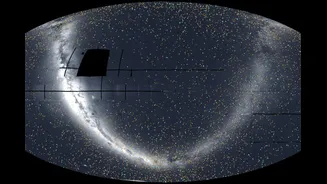
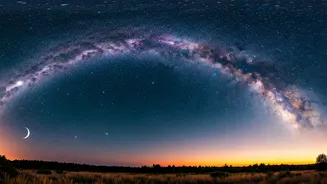
The heart of our galaxy, the Milky Way, presents a truly spectacular sight in mid-May, becoming prominent between midnight and dawn. It arcs high above the southeastern horizon, offering a breathtaking spectacle of dense starfields and dark interstellar dust clouds that form a glowing band. A helpful method for locating this galactic core is by identifying the Summer Triangle, an asterism formed by three exceptionally bright stars: Altair, Vega, and Deneb. This famous trio shines above the eastern horizon during this time of year. The Milky Way's luminous core appears to tumble towards the horizon, passing through Deneb and situated between Vega and Altair, creating a profound visual experience that highlights our place within the vast cosmic structure.
Planetary Parade
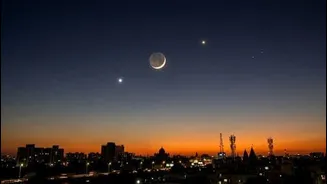
As the sun sets in May, turn your attention westward to witness Venus shining brightly as an 'evening star,' situated a little over twenty degrees above the horizon—roughly the span of two clenched fists held at arm's length. Higher and to the upper left of Venus, approximately another twenty degrees, lies Jupiter, with the distinct stars of Castor and Pollux from the Gemini constellation shining above it. A pair of 10X50 binoculars will reveal a swarm of star-like objects surrounding Jupiter: its four largest moons, Io, Europa, Ganymede, and Callisto, famously known as the Galilean Moons in honor of their discoverer, Galileo Galilei. For the early risers, the pre-dawn sky offers a different planetary ensemble. Saturn ascends above the eastern horizon, with Mars rising to its lower left, both appearing less than twenty degrees above the horizon at sunrise. Catching this planetary duo before the encroaching sunlight dims their visibility requires a clear eastern vista.