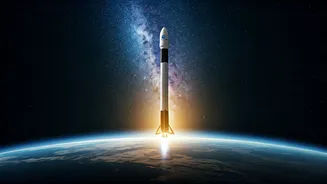

Historic Launch Event
On December 8th, SpaceX's Booster 1067 initiated a mission, carrying an upper stage and 29 broadband internet satellites. This launch was executed from
Complex 39A at NASA's Florida site at 5:26 p.m. EST (2226 GMT). The launch followed a one-day postponement attributed to adverse weather conditions. The Falcon 9 upper stage separated from the first stage after approximately two and a half minutes of ascent. Following this, it continued its journey with a coasting phase, and then a second firing of its Merlin engine, slated to deploy the satellites about an hour later. The mission was a success.
Milestone Flight History
This specific launch on December 8th marked SpaceX's 158th Falcon 9 launch of the year and represented the 510th reflight of a first stage since 2017. Furthermore, on December 7th, another set of 29 Starlink satellites were launched from Vandenberg Space Force Base in California. The first stage of the Falcon 9 rocket, which was used during the recent launch, set a new benchmark for a 'flight-proven' booster. After helping put Starlink satellites into a low Earth orbit, it landed for the 32nd time, showcasing the reusability and efficiency of SpaceX's technology.
Boosting Reusability Goals
The successful 32nd landing of the first stage is a noteworthy step toward SpaceX's long-term goal of flying its first stages 40 times. The booster, after separating from the upper stage, made a controlled, propulsive return to Earth. It then landed on the 'Just Read the Instructions' droneship, stationed in the Atlantic Ocean. This process emphasizes the company's commitment to optimizing space travel and reducing operational costs. By consistently reusing its rockets, SpaceX is pushing the boundaries of what is possible in space exploration and commercial space activities.
Expanding Starlink Network
The Starlink network currently includes over a vast number of satellites, all aimed at providing broadband internet access to regions around the world with limited connectivity. The service additionally offers WiFi connectivity on commercial airliners. Moreover, it is also supporting cell-to-satellite service on certain carriers. This expansion of the Starlink network reflects a broader aim to improve global internet access, delivering vital connectivity to underserved populations and enhancing communication capabilities for various sectors, including aviation and mobile services.