






Factory to Field
The genesis of a modern ski lift begins not on the slopes, but within the controlled environment of a factory. For approximately four to five months, meticulous
manufacturing processes in facilities like the one in Grand Junction, Colorado, are dedicated to crafting the components that will eventually form the backbone of vertical transportation at ski resorts. This extensive factory work precedes the more visible, yet rapid, on-site construction phase. Each lift is a unique engineering feat, custom-designed to suit the specific topography of its intended location and meet precise capacity demands. Building a completely new lift in an undeveloped area presents a distinct set of challenges compared to upgrading an existing one. These systems represent one of the most significant capital expenditures for a ski area, far exceeding investments in lodges, restaurants, or snowmaking equipment, due to their permanent nature and the impossibility of relocation once installed.
Navigating Bureaucracy
The journey from conceptualization to the first rider is a lengthy, multi-year undertaking, often spanning six years from initial design to operational status. This timeline is heavily influenced by a complex web of regulatory approvals and planning processes. Many ski areas operate on land leased from the Forest Service, necessitating a comprehensive master-planning phase, which for the Elk Camp lift, began in 2019. This is followed by extensive steps including consensus documentation by 2022, securing a Forest Service acceptance letter in 2023, obtaining local approvals in 2024, and undergoing a National Environmental Protection Agency (NEPA) environmental review typically lasting from 2024 to 2025. Only after these bureaucratic hurdles are cleared and further contract signings are completed can actual construction commence, as exemplified by the April 2025 start date for the Elk Camp project. This intricate approval process underscores the significant governmental oversight involved in developing such infrastructure.
Global Design Divide
A notable divergence exists between ski lift development in the United States and Europe, largely attributable to differing economic models. European resorts frequently feature more avant-garde and technologically advanced lift designs. This is often because the land and surrounding businesses are communally owned or heavily influenced by regional governance. Taxes levied on businesses that profit from the ski area's success directly fund infrastructure improvements, allowing for the construction of more ambitious and sophisticated machinery. This model also fosters competition among multiple lift manufacturers vying for projects within a single resort. In contrast, U.S. resorts often face a more fragmented ownership landscape, where individual land parcels may belong to various entities. This can lead to unique, context-specific lift designs, such as those found on a farmer's hillside, driven by the immediate revenue-generating potential of each installation, inspiring innovative, unconventional solutions.
Precision Aerial Installation
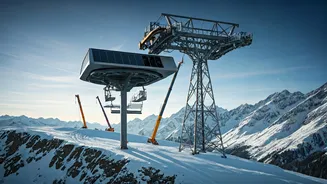
The physical construction of a ski lift on-site is a remarkable display of coordinated effort and specialized skill, often accomplished with astonishing speed. On a clear September morning, a powerful Black Hawk helicopter, capable of lifting up to 9,000 pounds, embarks on a multi-hour mission. Its task: to precisely place 21 chairlift towers, cross-arms, and sheaves—the wheels that guide the cable—onto pre-set threaded bolts with millimeter accuracy. This operation demands constant communication, with ground crews receiving instructions in inches from the helicopter pilot. Teams of installers, working in two 'catching crews,' manually guide these massive components, some 30 to 40 feet long, into their exact positions as the helicopter maneuvers them. Intense focus is critical, as straying from the direct path of the suspended load can have serious consequences. Workers manually tighten the initial bolts before quickly ascending the newly placed towers to install crossbars and sheaves, a process that transforms the mountainside with dazzling, dayglow-colored components amidst the swirling rotor wash.
Lifespan and Future Vision
The operational lifespan of a newly constructed ski lift is generally projected to be around 40 years before significant upgrades become necessary. For large resort operators with multiple mountains, like Aspen Skiing Company, which manages 40 chairlifts across four peaks, this means a new lift project is a near-annual consideration. The conceptualization phase for these future lifts can be one of the most creatively stimulating aspects of the job. Executives and planners often engage in imaginative brainstorming sessions, envisioning innovative solutions such as aerial transit systems to combat local traffic congestion or novel ways to connect different mountain areas. These grand visions, aimed at enhancing skier access and efficiency, ultimately depend on the successful execution of complex engineering feats, such as a 12,000-pound helicopter accurately positioning massive steel structures.
Final Touches and Celebration
Once the towers are securely in place and all components are fastened, the next crucial steps involve preparing the lift for operation. Following the hand-tightening of bolts, a massive drill bit is used to fully secure them. Subsequently, approximately six semi-trucks deliver the chairs, which are then meticulously installed onto the tensioned cable. The cable itself is precisely tensioned using a bull wheel. Before the lift can be officially opened to the public, engineers conduct rigorous testing to assess the load capacity of each chair, ensuring safety and reliability. The culmination of this extensive and often arduous process is the celebratory ribbon-cutting ceremony, marking the lift's readiness to serve skiers. For the Elk Camp lift, this celebratory event was scheduled for December 12, 2025, signifying the successful completion of a project that embodies significant dedication, hard work, and engineering ingenuity.