



Breaking Mars' Sound Barrier
In a significant stride for planetary exploration, NASA engineers have successfully propelled experimental helicopter rotors beyond the speed of sound
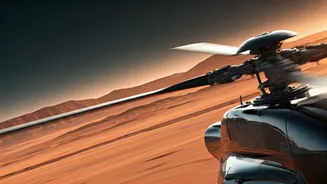
within a Mars simulation chamber. This pivotal development builds upon the legacy of the Ingenuity Mars Helicopter, which, originally planned for just five flights, ultimately completed an impressive 72 before its mission concluded in early 2024. Ingenuity's carbon-fiber blades operated at approximately 2,700 revolutions per minute, a speed roughly ten times that of conventional helicopters on Earth. However, engineers had deliberately kept Ingenuity's rotor tip speeds around Mach 0.7 to ensure blade integrity, as the effects of supersonic speeds were unknown. This new research, however, was driven by the need for enhanced performance in future missions. NASA engineers, anticipating potential challenges, even lined parts of the test chamber with sheet metal, unsure if the rotors would withstand the immense stresses of exceeding Mach 1. The successful tests, reaching Mach 1.08, mark a critical step towards understanding and harnessing supersonic flight on Mars, a feat previously considered risky.
Fueling Future Mars Missions
The motivation behind pushing helicopter rotor speeds on Mars is the pressing need for enhanced capabilities in next-generation aerial vehicles. "We want more performance from our next-gen Mars aircraft," stated NASA rotor test lead Jaakko Karras, following the achievement of Mach 1.08 rotor tip speeds. These crucial tests were a collaboration between NASA's Jet Propulsion Laboratory and a specialized aerospace company, who were instrumental in the development of the Ingenuity helicopter. The simulated Martian atmosphere within the test chamber mimicked the planet's thin air, which is about 1% as dense as Earth's at sea level. This research is directly linked to NASA's ambitious plans for future missions, including a proposed endeavor slated for launch as early as 2028. This next phase aims to deploy three helicopters designed to transport significantly heavier payloads than Ingenuity could manage, opening up new avenues for scientific discovery and exploration on the Red Planet.
Elevating Payload Capacity
The ability to achieve higher rotor speeds directly translates to increased lift, a crucial factor for enabling more substantial Mars missions. The recent tests demonstrated that the increased rotor speeds generated approximately 30% more lift. This enhanced lift capability could empower future Martian helicopters to carry larger, more powerful batteries and a greater array of sophisticated scientific instruments, thereby expanding the scope and depth of scientific investigations. Shannah Withrow-Maser, an aerodynamicist at NASA Ames Research Center, noted that while the team initially anticipated reaching around Mach 1.05, the actual test runs surpassed expectations, hitting Mach 1.08. Researchers are diligently analyzing the collected data, with preliminary findings suggesting that further improvements in thrust may still be achievable. These advancements are fundamental to designing the next generation of helicopters, which are expected to operate with a greater degree of autonomy than Ingenuity, potentially communicating directly with Earth or utilizing orbiting satellites while conducting in-situ analysis of subsurface ice deposits.