






Understanding Solar Eclipses
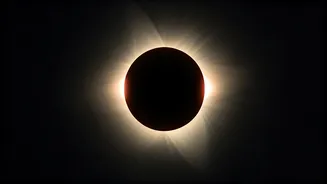
A total solar eclipse occurs when the Moon perfectly aligns between the Earth and the Sun, completely obscuring the Sun's bright disk. During totality,
the sky darkens dramatically, resembling twilight, offering viewers a chance to witness the Sun's outer corona. Conversely, an annular solar eclipse happens when the Moon is farther from Earth, appearing smaller and unable to fully cover the Sun. This results in the stunning 'ring of fire' effect, where a brilliant ring of sunlight surrounds the Moon's silhouette. These celestial events provide unique opportunities to learn about our solar system.
The 2026 Annular Eclipse
The upcoming annular solar eclipse on February 17, 2026, promises a captivating display. Primarily visible over Antarctica, the path of annularity commences in the southern Indian Ocean, traversing Antarctica's coastal regions near the Ronne Ice Shelf, before concluding in the southern Atlantic Ocean. The greatest eclipse is predicted at 12:11 UT (17:41 IST), with maximum annularity expected to last up to 2 minutes 20 seconds. Partial phases will be viewable in southern Africa, South America, and the surrounding oceans, offering glimpses of this phenomenon to a wider audience.
The 'Ring of Fire' Effect
The 'ring of fire' effect is a visually striking characteristic of an annular solar eclipse. When the Moon is positioned farther from Earth during its orbit, it appears too small to completely cover the Sun. Consequently, a brilliant ring of sunlight remains visible around the Moon's silhouette, creating a spectacular, fiery donut shape in the sky. This stunning sight arises because the Moon covers approximately 96% of the Sun's disk at its maximum coverage.
Safe Viewing Practices
Protecting your eyes is paramount when observing a solar eclipse. Never look directly at the Sun without proper eye protection. For all solar phases, including partial and annular eclipses, use certified solar eclipse glasses that meet the ISO 12312-2 international safety standard. These glasses ensure a safe and enjoyable viewing experience. Another option is to watch live streams from observatories and space agencies; this offers expert explanations. Always prioritize safety to ensure lasting memories of these celestial events.
Eclipse Visibility in India
Unfortunately, the February 17, 2026, annular solar eclipse won't be visible from India. Although the eclipse will occur in the late afternoon or early evening by Indian time, the Sun will be below the horizon for observers in India. The alignment of the Earth, Moon, and Sun positions the event far south, making it impossible to witness the 'ring of fire' or even a partial view from the subcontinent. This is due to geographical limitations, not local weather conditions, meaning live viewing won't be possible despite the buzz.
Looking Ahead to 2026
Skywatchers eager for the next total solar eclipse will have to wait until 2026. The last total solar eclipse in North America occurred in April 2024. The 2026 event provides a fantastic opportunity to see the moon fully covering the sun's fiery face, revealing its stunning corona. This event should be a spectacular display. Planning ahead for lunar and other upcoming eclipses is recommended; preparing allows enthusiasts to make the most of each event.