




Lunar Surface Priority
NASA is fundamentally altering its lunar exploration roadmap, shifting resources away from the planned Gateway lunar station to concentrate on establishing
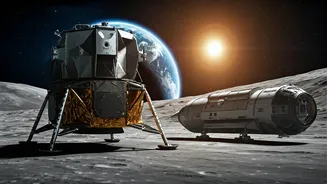
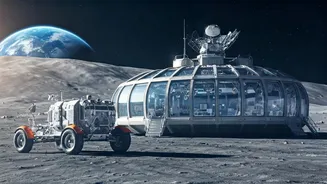
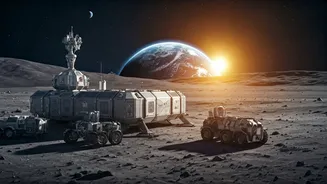
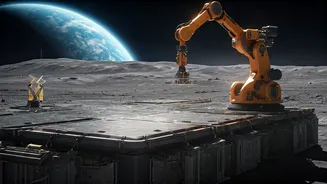
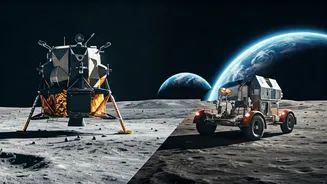
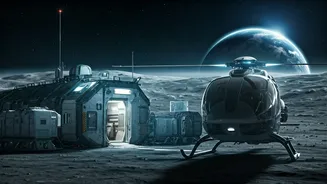
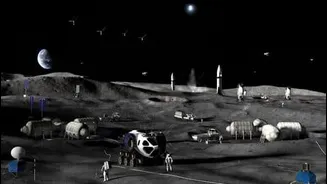
a permanent human presence on the Moon's surface. This strategic redirection aims to accelerate the development of a lunar base, with plans for frequent crewed missions post-Artemis IV and V. The initiative will lean heavily on commercially sourced, reusable hardware, targeting a cadence of one mission every six months. The lunar base concept will be developed in phases, building on existing international partnerships and significantly amplifying the capabilities of the Commercial Lunar Payload Services (CLPS) program. This program will facilitate up to 30 robotic landings at the lunar south pole starting in 2027, delivering a diverse array of payloads including rovers, hoppers, and drones from various sectors. NASA anticipates an investment of approximately $20 billion over the next seven years for the lunar base and an additional $6 billion for enhanced CLPS operations in the coming decade. This reallocation of funds, which requires Congressional approval, signifies a deliberate choice to concentrate resources on tangible surface exploration.
Commercial Space Station Strategy
The agency is also revising its strategy for future orbital destinations beyond the International Space Station (ISS). Recognizing a lack of compelling commercial products, substantial tourism interest, and international government funding for long-duration orbital access on U.S.-based commercial platforms, NASA proposes a modified approach. Instead of immediately transitioning to entirely new commercial space stations, NASA plans to extend the operational life of the ISS, potentially through the mid-2030s. This extension will involve attaching a new, government-owned module, followed by additional commercial modules. The vision is that this integrated system could eventually detach from the aging ISS and continue to operate independently as a smaller, dedicated space station, ensuring continued access to low Earth orbit for research and development.
Advancing Mars Exploration
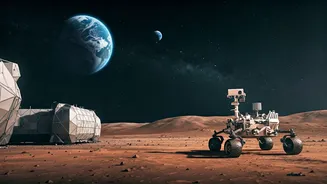
Long-term ambitions for Mars exploration are being bolstered with plans for a comprehensive Mars Telecom Network to support future operations and scientific payloads. A key announcement involves a new mission, Space Reactor-1 Freedom, slated for launch before the end of 2028. This pioneering mission will be the first to employ advanced nuclear electric propulsion for transit to Mars. Upon arrival, it will deploy a payload of Ingenuity-class helicopters, designed to scout potential landing sites for future crewed missions and actively search for evidence of subsurface water ice, a critical resource for sustained human presence and scientific research on the Red Planet.
New Science Opportunities
NASA's science division is also highlighting progress and new avenues for discovery. Missions like the Nancy Grace Roman Space Telescope are ahead of schedule and under budget, while Dragonfly's launch to Titan is confirmed for 2028, and NASA will be responsible for launching and landing ESA's Rosalind Franklin rover. Updates were also provided on missions to Venus (DAVINCI) and the asteroid-hunting NEO Surveyor, targeting a 2027 launch. A key focus is reducing the "time to science," with new opportunities to rapidly integrate scientific investigations onto upcoming CLPS missions, particularly those that can yield valuable data regardless of their specific landing site. Furthermore, NASA is actively seeking mission concepts suitable for philanthropic or private partnerships, with suggestions including planetary defense follow-ons, interstellar probes, and a Uranus orbiter. These strategic shifts are set to be implemented in the coming months.