




Distant Galaxies Emerge
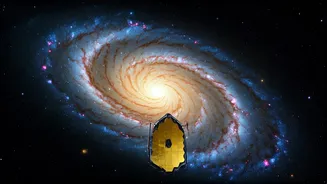
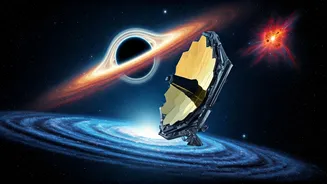
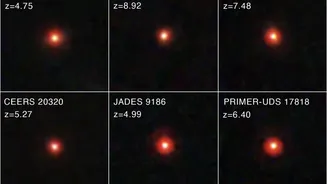
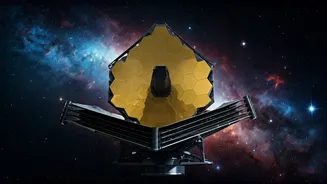
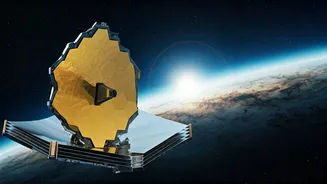
The James Webb Space Telescope has achieved a monumental feat, detecting galaxies that existed much earlier in the universe's history than previously thought
possible. These celestial bodies are presenting a puzzling picture for astronomers, as their characteristics do not align with current theoretical models of galactic evolution. This unprecedented observation suggests that our understanding of how the first galaxies formed and developed may need significant revision. The Webb's advanced infrared capabilities allow it to peer through cosmic dust and distance, capturing light that has traveled for billions of years, thus providing a unique window into the universe's formative stages. The sheer existence and unexpected nature of these extremely distant galaxies are prompting a reevaluation of cosmological timelines and the fundamental processes governing the early universe.
Comets and Stellar Seeds
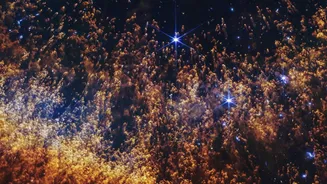
In a captivating display, the James Webb Space Telescope has captured images of crystals, often associated with comets, actively flowing far from a nascent star. This observation provides a rare glimpse into the materials present in the protoplanetary disk, the swirling cloud of gas and dust from which planets form. The presence and movement of these crystalline structures so far from the central star suggest that the building blocks of comets might be distributed more widely in these early stellar systems than previously assumed. Understanding these processes is crucial for comprehending the delivery of water and organic molecules to forming planets, potentially influencing the origins of life. The Webb's detailed resolution allows astronomers to study the composition and dynamics of these disks with remarkable precision, offering vital clues about planetary system formation.
Black Hole's Cosmic Jet
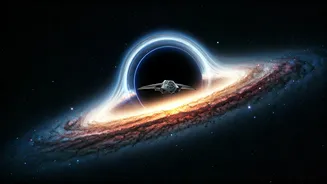
Astronomers have witnessed an extraordinary event: the first black hole ever imaged has unleashed a colossal jet of material, extending an astonishing 3,000 light-years into space. This powerful outburst emanates from the immediate vicinity of the black hole's 'shadow,' the region where light is unable to escape its gravitational pull. Observing such a massive jet provides critical data on the energetic processes occurring around supermassive black holes and how they interact with their galactic environments. The sheer scale of this jet challenges existing theories about black hole accretion and the mechanisms by which they launch such enormous outflows of plasma. This discovery offers a unique opportunity to study the physics of extreme environments and the powerful forces at play in the universe.
Early Universe Peculiarities
The James Webb Space Telescope continues to unveil the mysteries of the early universe, recently discovering what appears to be the first evidence of 'dinosaur-like' stars. These hypothetical massive, metal-free stars are thought to have been the first generation of stars to form after the Big Bang. Their existence, if confirmed, would significantly alter our understanding of stellar evolution and the chemical enrichment of the universe. Webb's sensitivity to infrared light allows it to detect the faint signatures of these ancient stellar populations, which would be invisible to other telescopes. Furthermore, the telescope has spotted a gassy baby galaxy exhibiting remarkably energetic behavior in the early universe, described as throwing a 'tantrum.' This suggests that galaxies in their infancy may be far more dynamic and volatile than current models predict, further challenging our cosmic narratives.
Cosmic Anomalies and Dark Universe
Artificial intelligence is proving to be an invaluable tool in astronomical research, as evidenced by its discovery of hundreds of previously unseen 'cosmic anomalies' within archival Hubble Telescope images. These anomalies could represent entirely new types of celestial objects or phenomena, opening up new avenues of scientific inquiry. Simultaneously, the James Webb Space Telescope has provided scientists with the clearest picture yet of the dark universe, a realm that has long eluded detailed observation. This achievement represents the culmination of years of effort and marks a significant milestone in our quest to understand the universe's composition and evolution, particularly concerning dark matter and dark energy. The ability to probe these enigmatic components of the cosmos is crucial for a complete cosmological model.
Exoplanets and Supernovae
The search for habitable worlds beyond our solar system has yielded intriguing results with the discovery of a 'cold Earth' exoplanet located just 146 light-years away. While potentially within its star's habitable zone, its existence there is contingent on further verification. Adding to the Webb's impressive catalog, the telescope has also observed the oldest supernova ever detected. This ancient stellar explosion offers a unique opportunity to study the conditions and chemical composition of the universe at a much earlier epoch than previously possible. These discoveries underscore the James Webb Space Telescope's dual capability in exploring both the far reaches of the universe and the nuances of planetary habitability, pushing the boundaries of our cosmic knowledge.